
Tokenization: The $16 Trillion Shift Coming
Everyone thinks tokenization is crypto hype that fizzled. Heres whats actually happening, wherever you are reading this.

First time here? Everything we write traces back to one idea that the worlds money and assets are quietly being rebuilt on shared digital rails, and the people who see it early get to position before the crowd. The 2-minute version is pinned here: One Planet, 180 Currencies.
Naked Market breaks down macro finance, blockchain infrastructure, AI systems, and automated trading to help you understand the future of global finance before the mainstream catches up.
Say the word tokenization out loud and watch what happens in your own head.
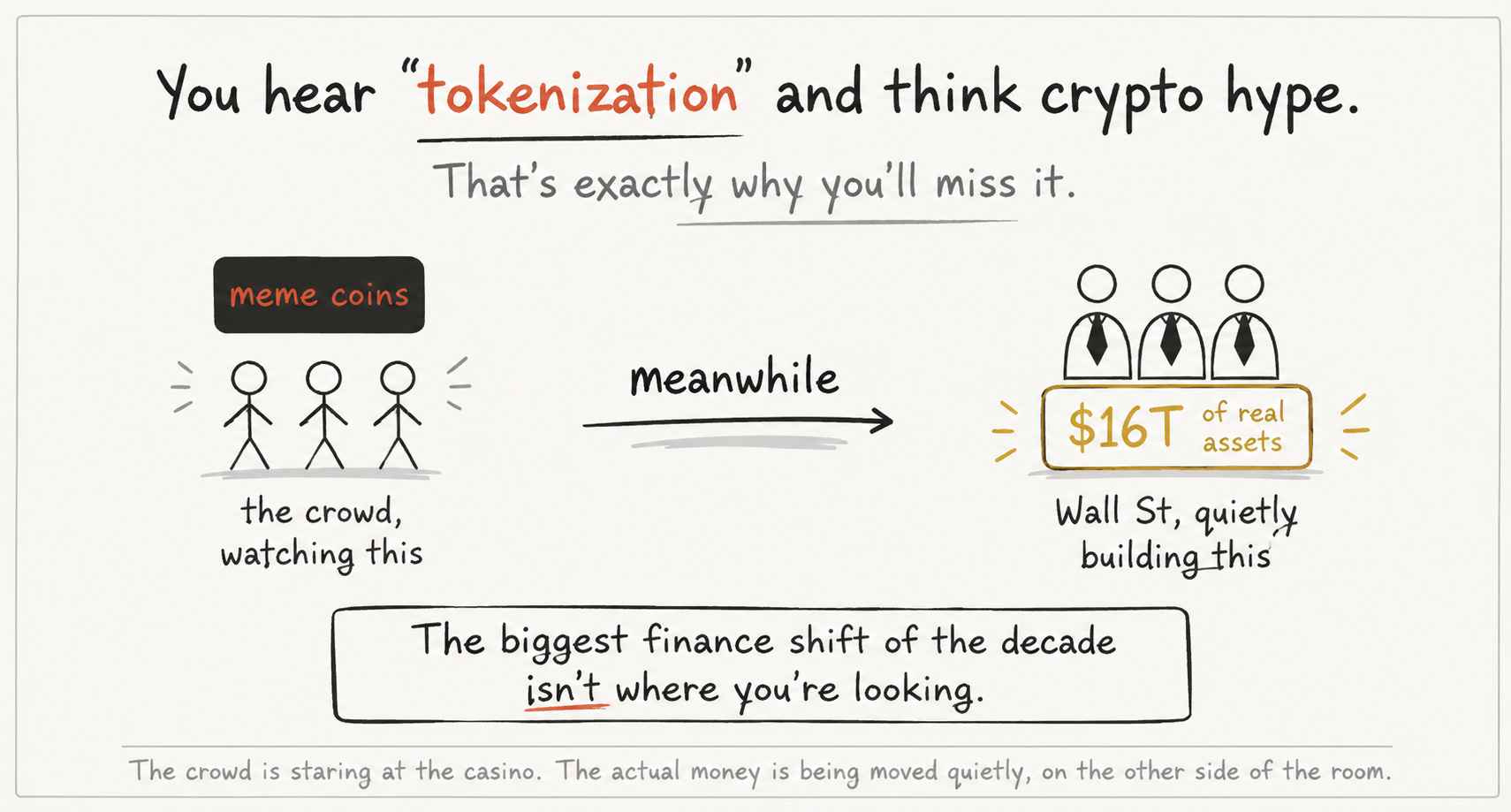
For most people, the brain fills in the blanks instantly: crypto. NFTs. Bored apes. Some 2021 buzzword that got hot, made a few people rich, and then collapsed. A casino dressed up in tech language. Been there, missed it, moved on.
That reflex is completely understandable. Its also exactly why most people are about to miss one of the biggest infrastructure shifts in the history of finance because the shift isnt coming from where theyre looking. Its not being built by anonymous founders in hoodies. Its being built by the most boring, most powerful institutions on the planet. In suits. With regulators nodding along.
The number being thrown around is $16 trillion by 2030. Lets take that apart honestly what tokenization actually is, who is really building it, why its happening right now, and what it means for you no matter which country you wake up in.
First, what tokenization actually is
Strip away the jargon and tokenization is almost embarrassingly simple. You take a real thing that already exists - a government bond, a share in a fund, a slice of a building, a stock and you wrap its ownership in a digital token that lives on a blockchain.
Thats it. Youre not inventing a new asset. Youre putting an old asset in a new container. The bond is still a bond. The building is still a building. But now ownership of it can move around the world in seconds, settle instantly, split into tiny fractions, and follow programmable rules - the same way an email moves compared to a posted letter.
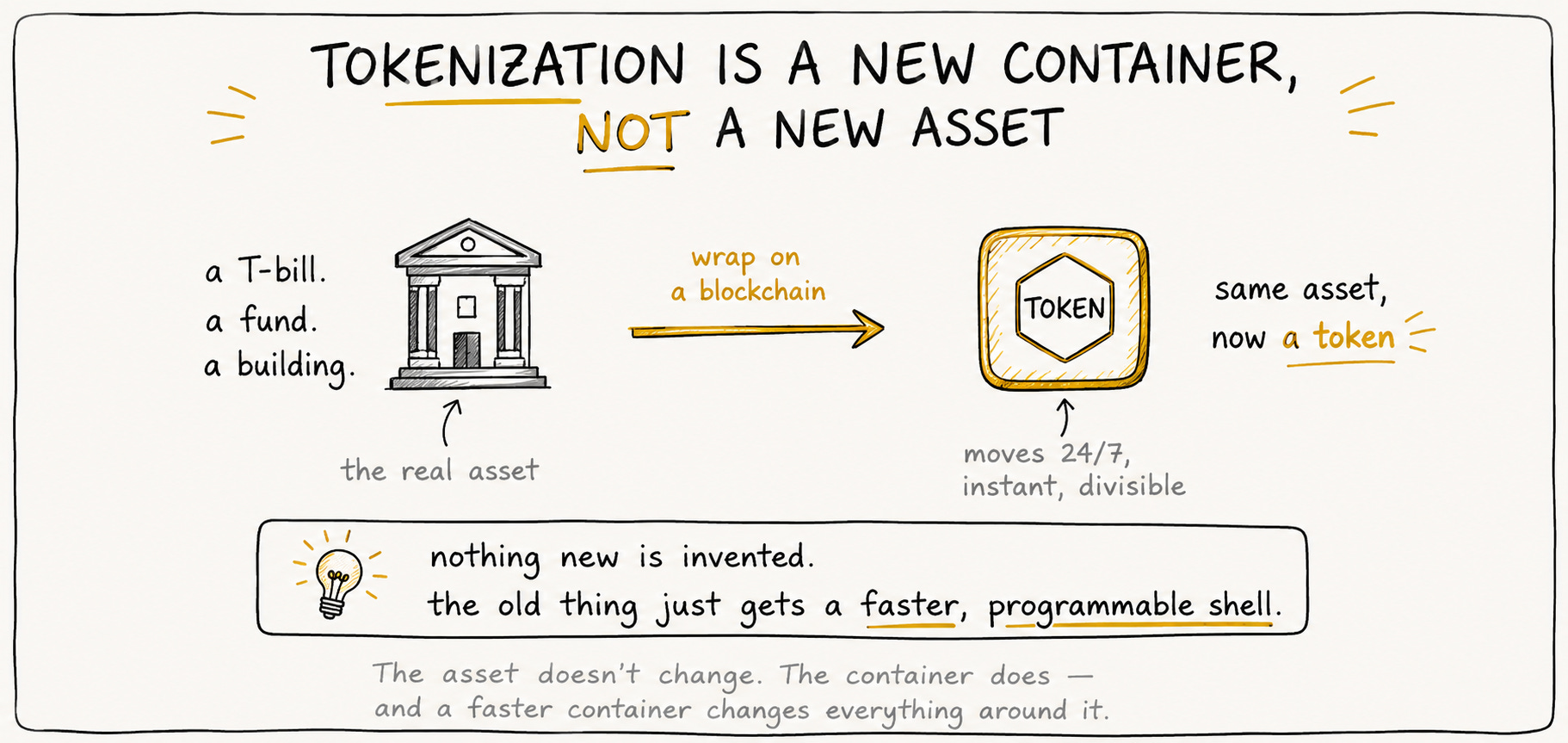
This is the single most important mental switch in the whole topic. The crypto coins you hear about in the headlines are mostly bets on nothing but their own price. Tokenized real-world assets are the opposite: theyre claims on real, boring, yield-producing things, just running on better plumbing. One is a lottery ticket. The other is the rebuilding of how ownership itself gets recorded and moved.
The $16 trillion number, decoded honestly
Heres where most articles lie to you by being too confident. So let me be straight: nobody actually knows the number.
The famous $16 trillion figure comes from a Boston Consulting Group study - its their base case for the value of tokenized assets by 2030, roughly 10% of global GDP. But run down the other forecasts and youll see how wide the range really is. McKinsey is far more cautious, somewhere around $2-4 trillion. The World Economic Forum has floated $10 trillion. Standard Chartered has gone as high as $30 trillion later in the decade. BCGs own bull case is a frankly silly-sounding $68 trillion.
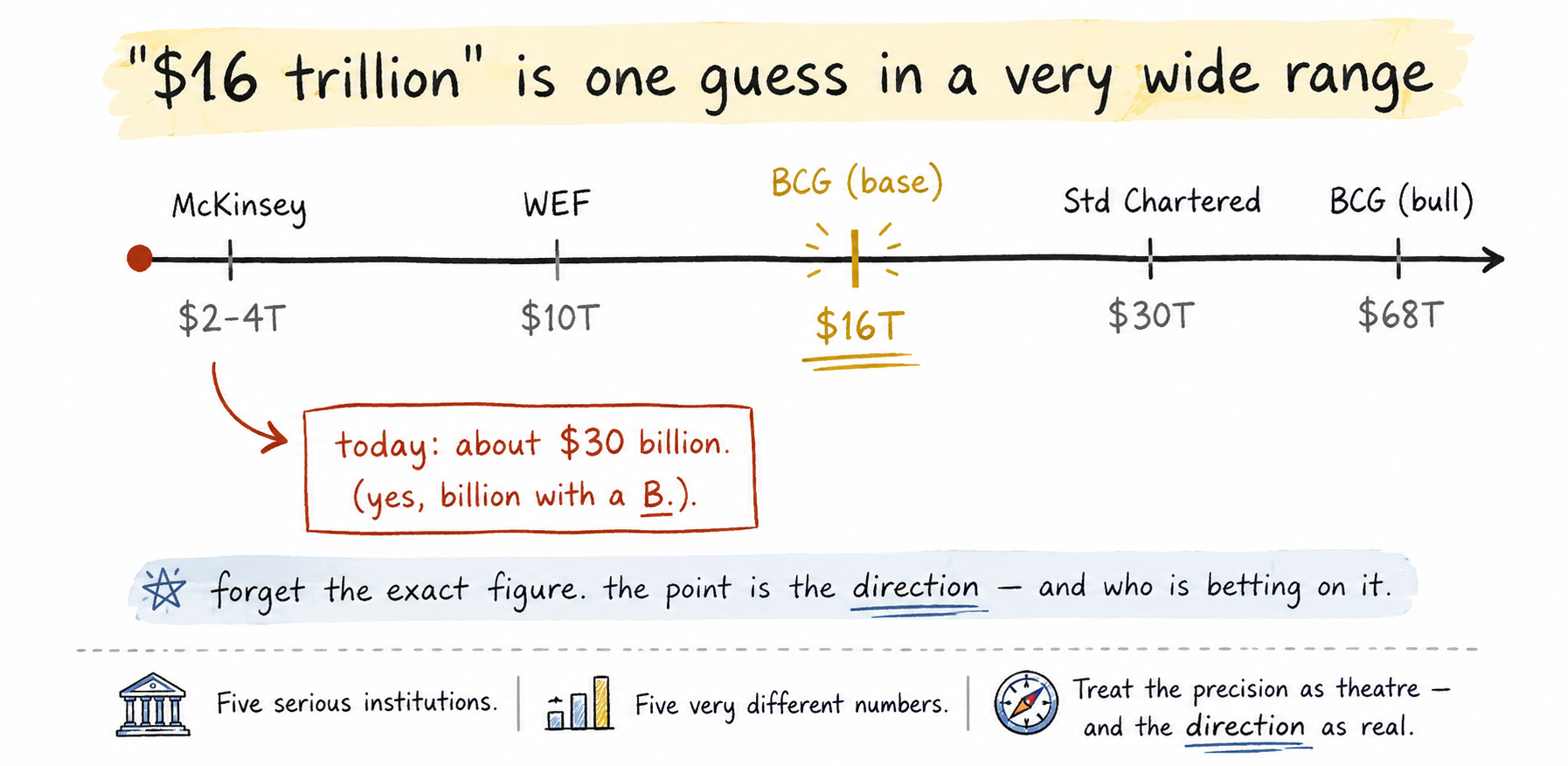
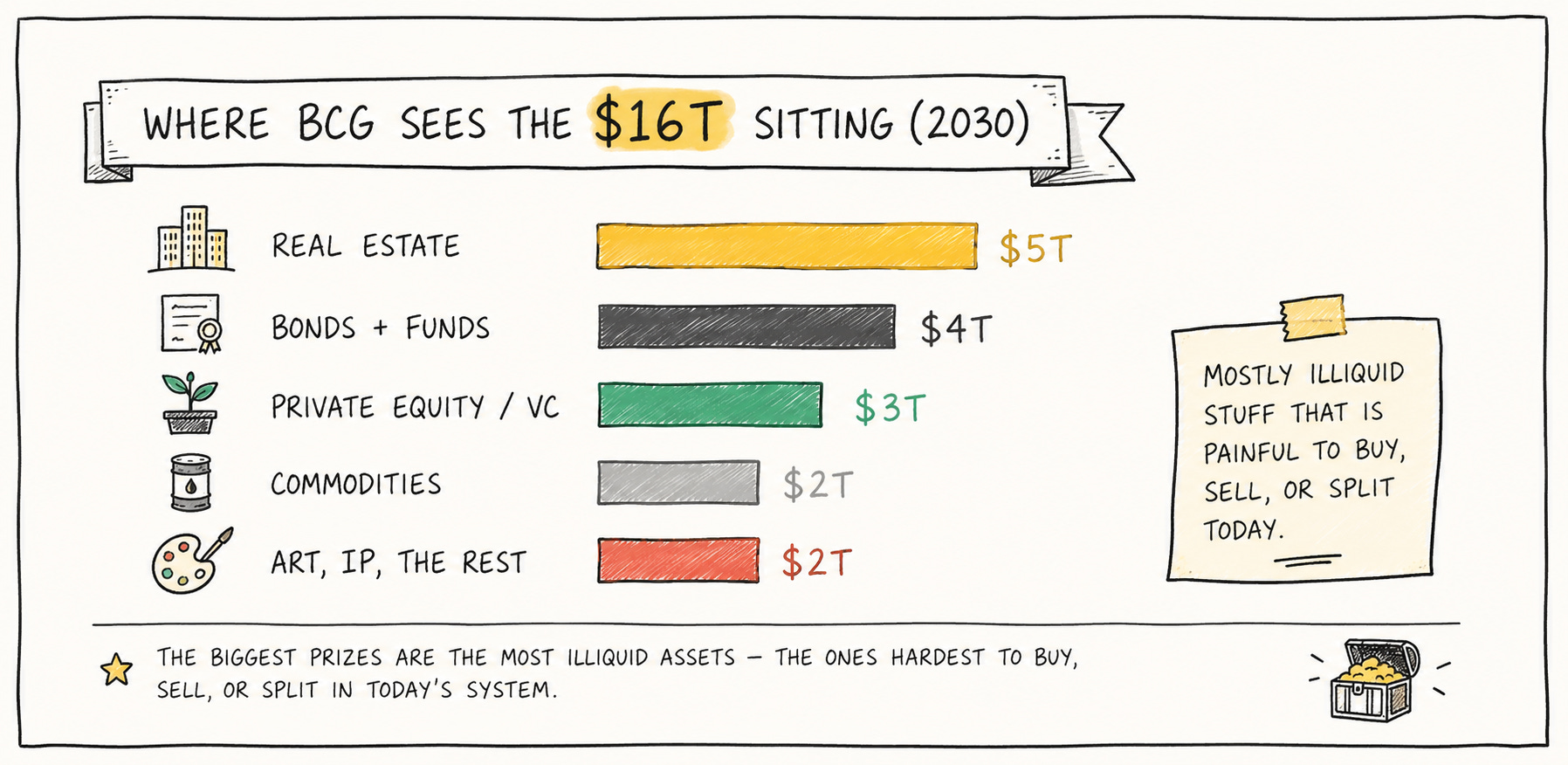
So dont anchor on the exact figure - anyone quoting $16 trillion like its a fact is selling something. What matters is two things the forecasts all agree on: the direction is up and to the right, and the people making these forecasts are the ones moving real money today. When BCG models where the value sits, it lands mostly in the assets that are painful to trade right now - real estate, bonds and funds, private equity, commodities.
The real tell: who is actually building this
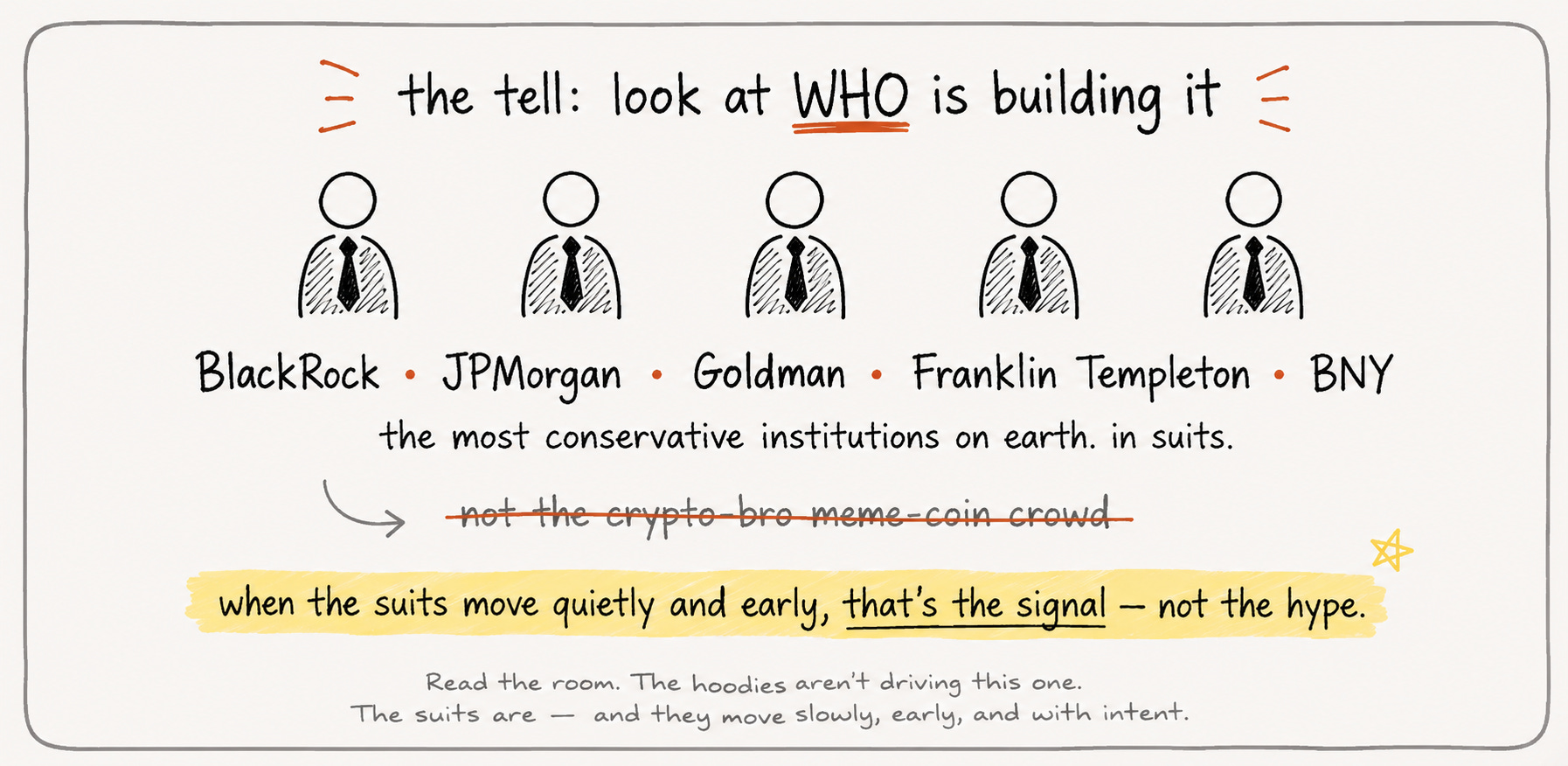
If tokenization were just another crypto fad, youd expect to see the usual crypto crowd hyping it. Instead, look at the names that have gone live.
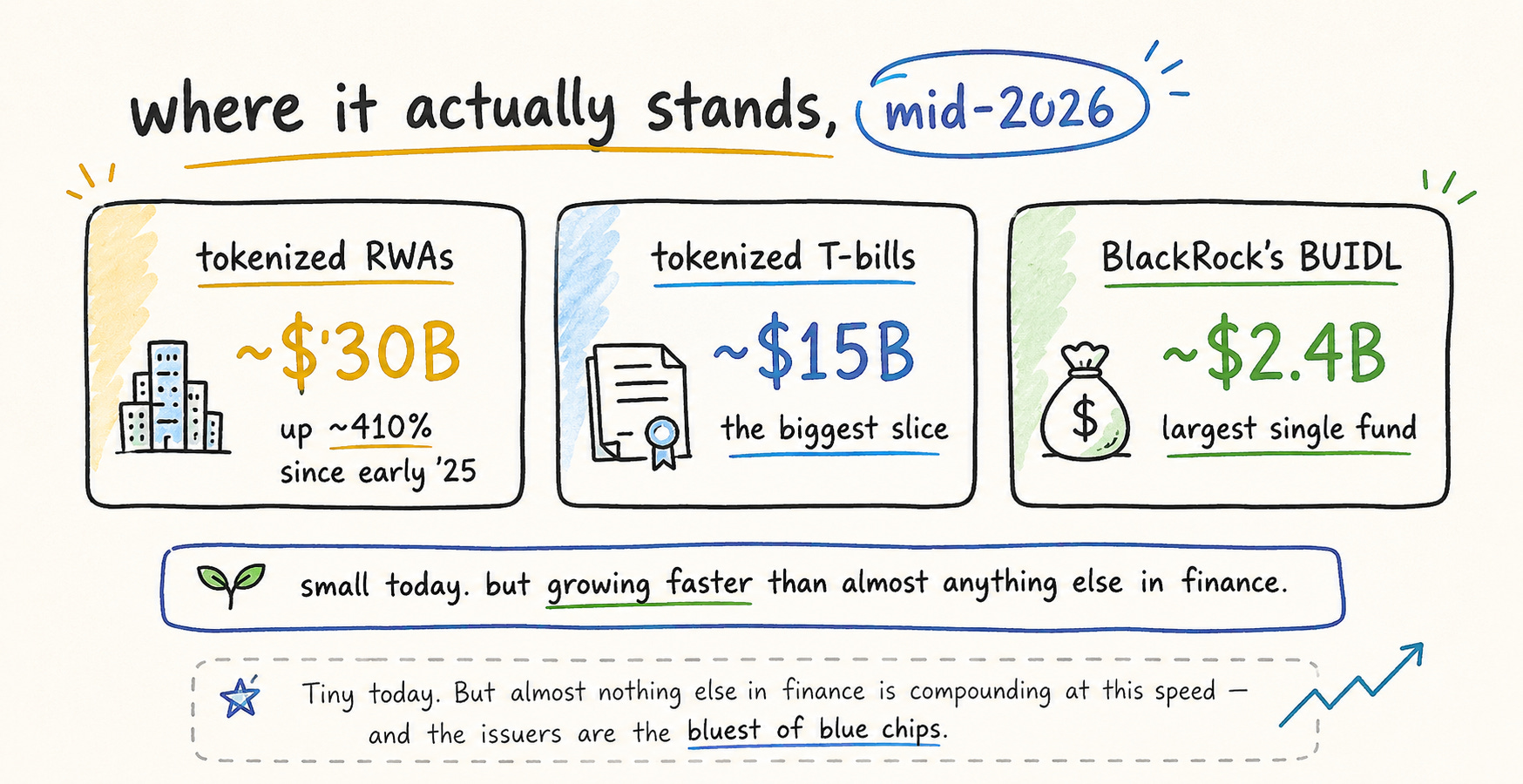
BlackRock - the largest asset manager on earth, around ten trillion dollars under management launched a tokenized fund called BUIDL in early 2024. Its now the biggest single tokenized real-world asset product, holding billions, and it has quietly paid out over a hundred million dollars in dividends to token holders. Its CEO, Larry Fink, has spent the last two years openly calling tokenization the future of markets. In May 2026, BlackRock filed for two more tokenized funds and on-chain shares of one of its big money-market funds. This is not a side experiment. Its a roadmap.
JPMorgan - yes, the bank whose own CEO once called Bitcoin a fraud now runs an entire blockchain unit (Kinexys, formerly Onyx), launched a tokenized money-market fund in late 2025, filed for another in 2026, and did the first tokenization of a private-equity fund on its own chain. Goldman Sachs, BNY Mellon, Franklin Templeton, Fidelity all of them are now in. The pattern isnt subtle.
When the crypto crowd hypes something, thats noise. When the most conservative institutions on earth quietly build it with their own balance sheets, thats the signal.
If the idea that big banks are already deep in blockchain surprises you, it shouldnt weve walked through how this started before: your bank is already using DeFi (they just dont call it that). And to be clear-eyed, this is still early. The whole tokenized real-world asset market is only around $30 billion today yes, billion with a B, a rounding error next to the trillions being forecast. But it has grown roughly 400% in about a year, and most of that is tokenized US government bonds.
Tokenization has been technically possible for years. So why is it suddenly a land-grab? Two things changed at once.
First, the money. Theres roughly $300 billion sitting in stablecoins - digital dollars used all over the crypto economy and most of it earns its holders nothing. Meanwhile, safe US government bonds pay around 4%. Thats an enormous pile of idle cash sitting next to free yield. Tokenize the bond, put it on-chain, and suddenly that idle money can capture the yield while staying digital and instant. Thats the entire engine behind tokenized treasuries exploding.
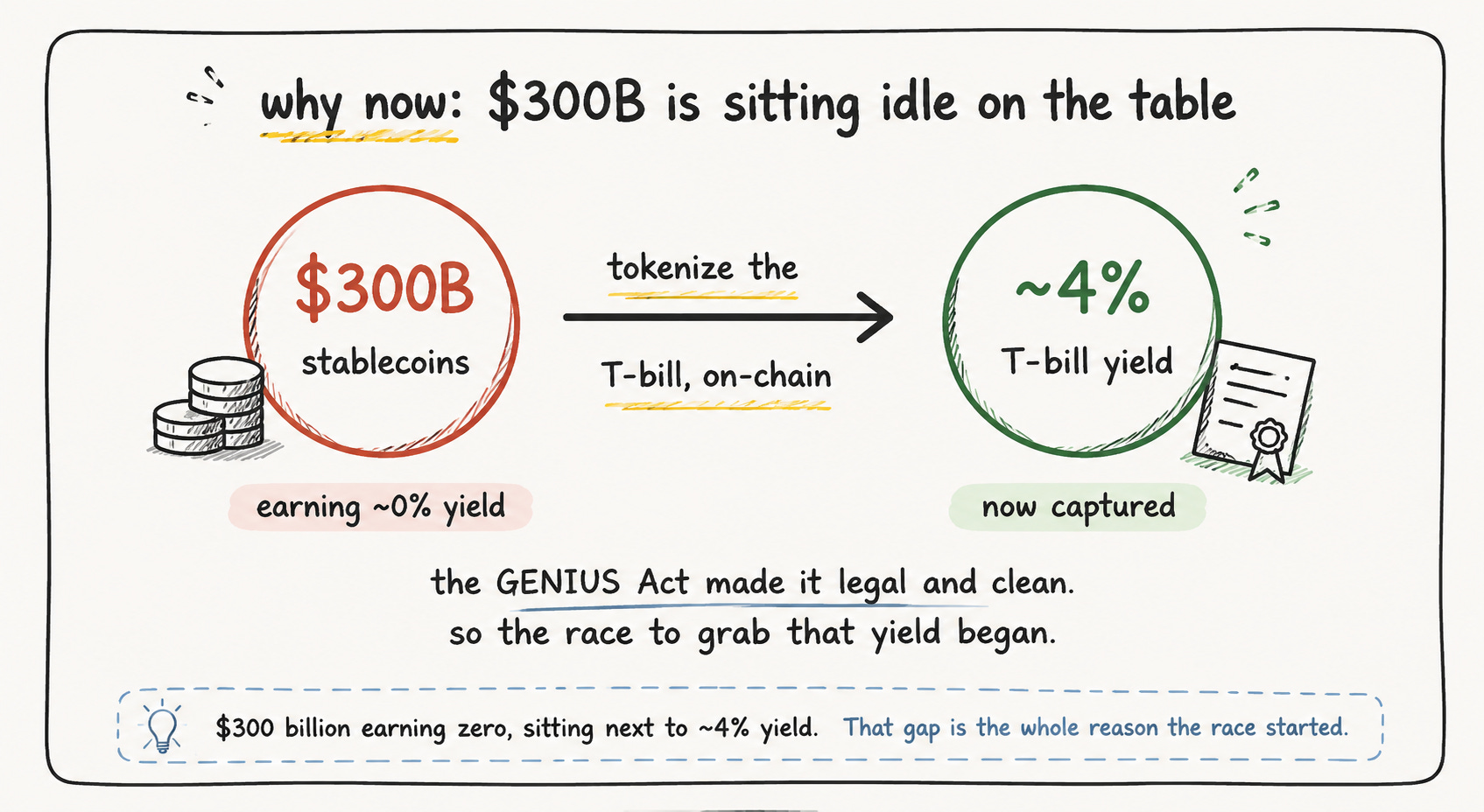
Second, the rules. In July 2025 the US passed the GENIUS Act - its first real framework for stablecoins, with hard rules on reserves and audits. Boring on the surface, but it did something huge: it made tokenized government bonds the natural, legal reserve asset to back those digital dollars. Thats why BlackRock and JPMorgan are racing to build tokenized money-market funds aimed squarely at stablecoin issuers. Regulation didnt kill this - regulation is what set it loose. If you want the deeper story on how stablecoins quietly became the on-ramp for all of this, we broke it down here: how a casino chip became the dollars newest export.
The upgrade nobody finds sexy: settlement
Heres the part that doesnt trend on social media but matters more than any price chart. Right now, when you buy a stock, the trade doesnt truly settle for a day or two. A whole chain of middlemen - brokers, clearinghouses, custodians has to shuffle records around behind the scenes. Markets close on nights and weekends. Money gets stuck in transit. Trillions sit idle waiting for the plumbing to catch up.
Tokenized assets collapse that. Trade and settlement become the same instant event, around the clock, with the middle layer largely automated away. Its the difference between posting a cheque and sending a text.
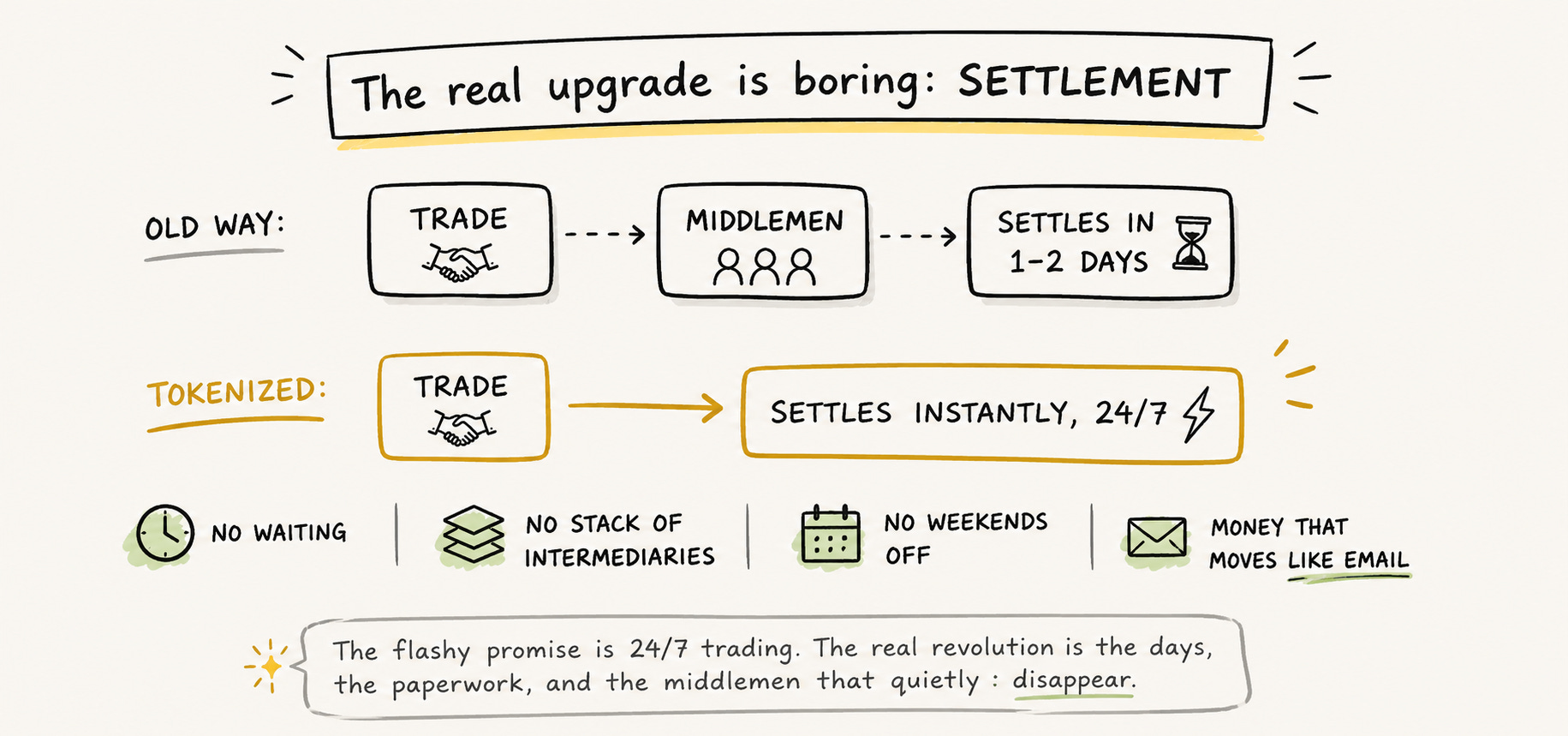
This is why this newsletter keeps banging on about the unglamorous stuff — the settlement layer is where the actual money and power live. We gave it its own piece here: what “settlement layer” really means.
The part you can already touch (and its catch)
So far this is mostly an institutional story - funds, bonds, banks. But theres a consumer-facing edge already live, and its tokenized stocks.
Platforms like Kraken (through a Swiss issuer called Backed) and Robinhood have put hundreds of tokenized US stocks and ETFs on-chain - Apple, Tesla, Nvidia, the S&P 500, all of it. You can buy a fraction of a share for a dollar, trade nights and weekends, and in many cases hold the token in your own wallet. For someone in São Paulo or Lagos or Jakarta who wants Nvidia exposure on a Sunday night, this is the first time thats genuinely possible. Hundreds of thousands of people already hold these.
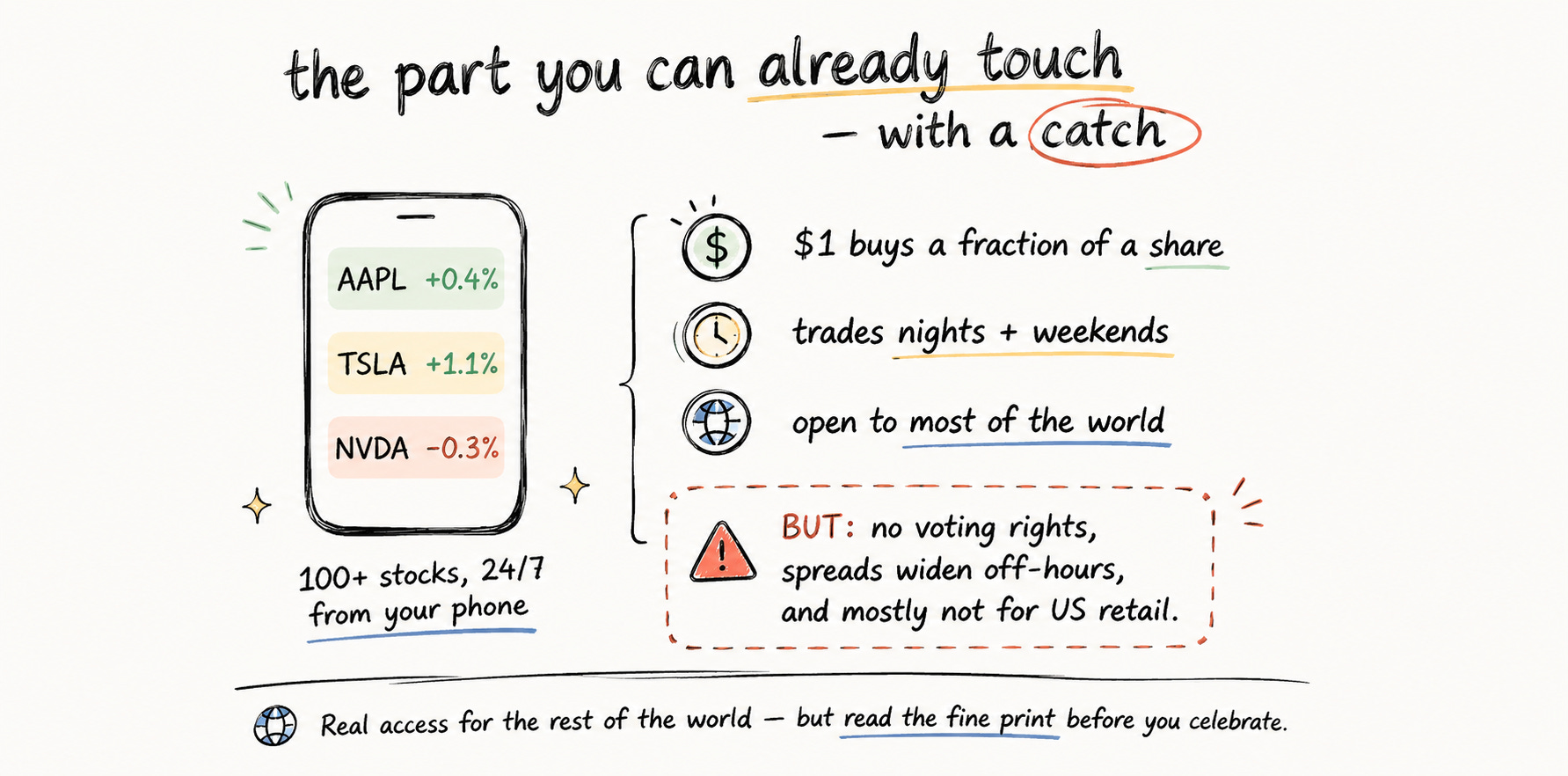
And now the honesty this newsletter owes you. A tokenized stock is not the same as owning the share. In most cases you get the price exposure but no voting rights. When the underlying US market is closed, the price can drift and the spread can widen, because a market maker is carrying the risk. And thanks to regulation, most of these products are not available to US retail at all — its the rest of the world getting first access, which is its own fascinating signal. Useful, real, growing — but not magic. Know exactly what youre holding.
Why we keep coming back to this
Zoom out, and tokenization isnt a standalone trend. Its one floor of a building weve been mapping issue after issue.
At the bottom are the rails shared, open, always-on blockchains. On top of that sits the new digital money: stablecoins, and the central bank digital currencies governments are racing to launch. And the top floor the one were watching get built right now is the assets themselves: bonds, funds, stocks, property, all becoming tokens that can move on those same rails, in the same instant, in the same global pool of liquidity.
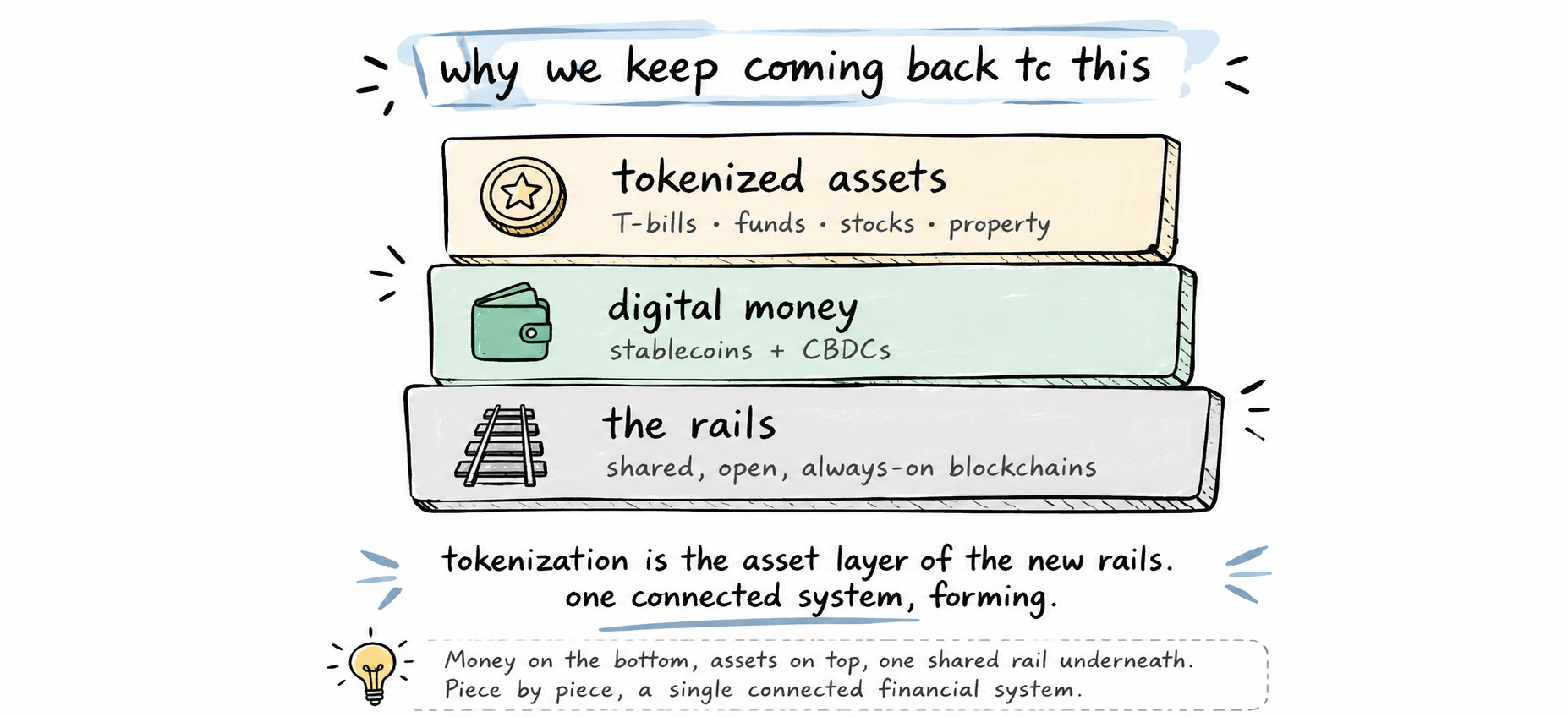
Put those layers together and you get the thing this whole publication is named after the absence of a financial world with the seams hidden. Not literally one currency, but one connected set of rails the whole planet can plug into, where value moves as freely as information does today. Tokenization is the asset layer of that future. We laid out the full vision here: the new rails, and what todays fragmented system quietly costs every one of us: what 180 currencies actually cost.
The honest version - don’t get carried away
Now let me pull you back down, because every hype cycle needs a sceptic and this newsletter would rather be the sceptic than the cheerleader.
That $16 trillion is a destination, not where we are. Were at roughly $30 billion. Thats a five-hundred-fold gap, and gaps like that are paved with broken promises. Regulation is still half-written outside a few jurisdictions. Custody and issuer risk are real - a token is only as trustworthy as whoever holds the actual asset behind it. And as we just saw with tokenized stocks, the token doesnt always give you the full rights of the real thing. There will be blow-ups. There will be scams wearing the word “tokenized” like a costume.
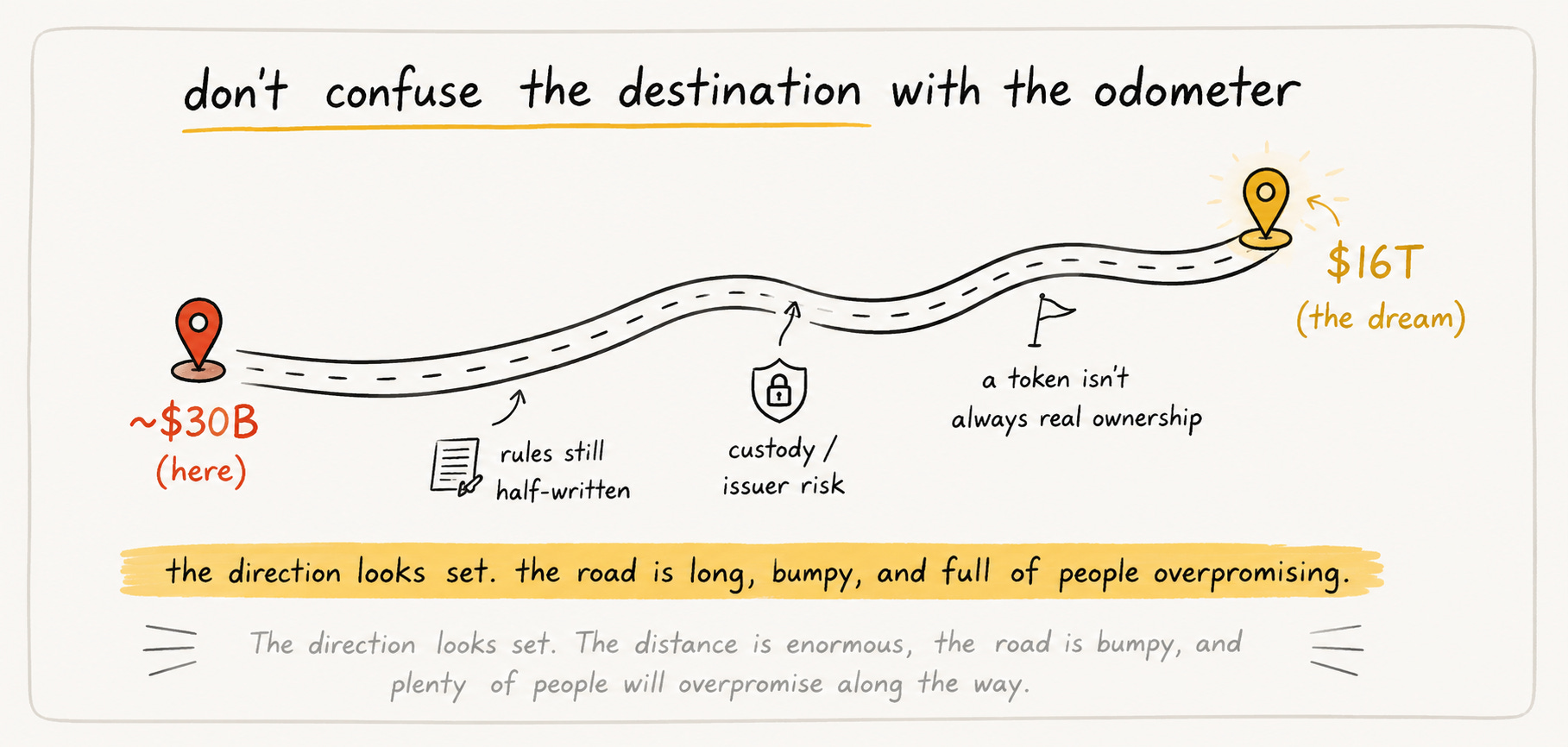
None of that changes the direction. It just means the smart move is to understand the shift clearly, not to chase the first shiny token that uses the word.
Your filter, so you never get fooled
You dont need to predict winners. You need a test you can run on anything that calls itself tokenized - this year or five years from now. Four questions.
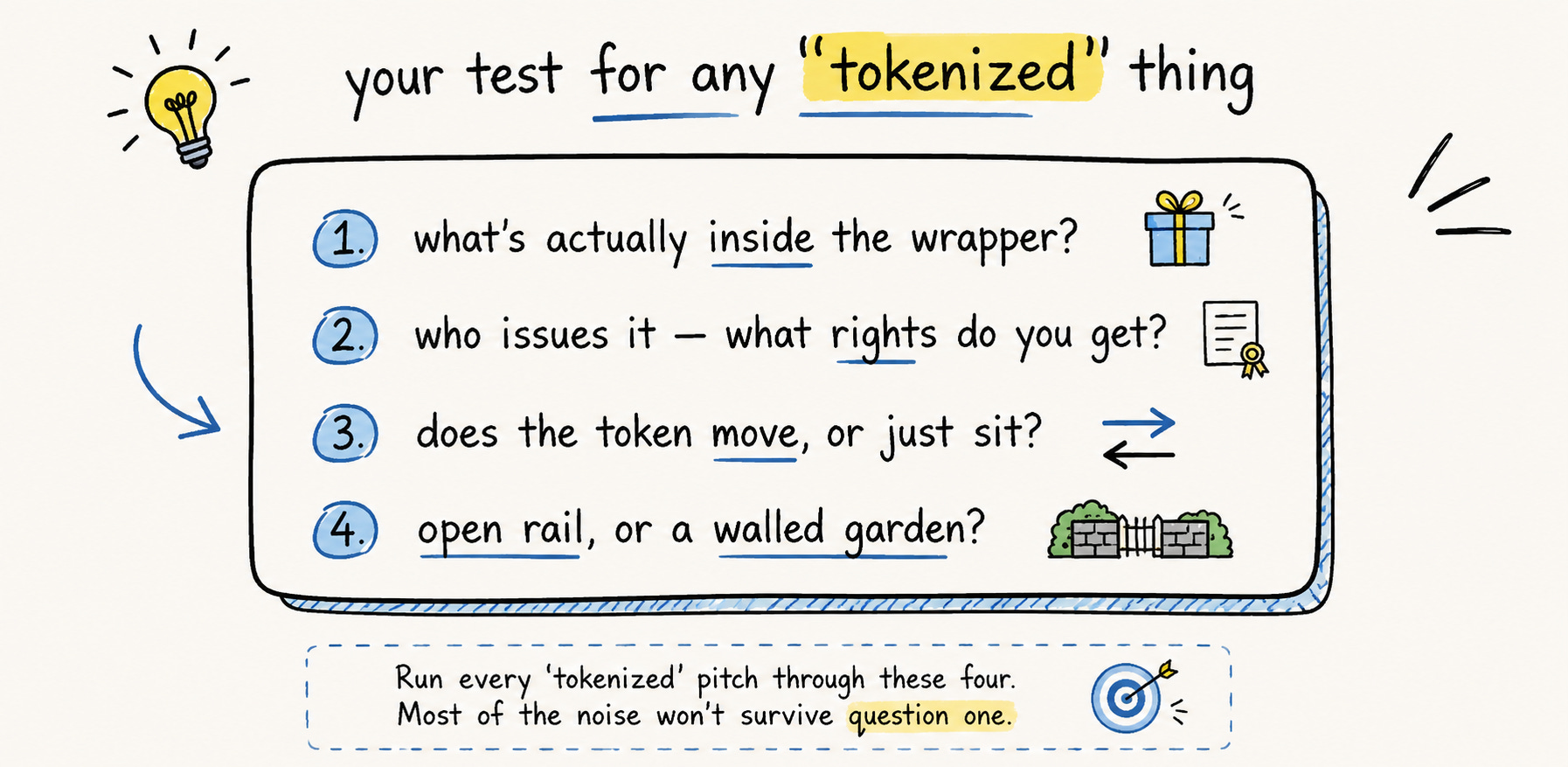
What’s actually inside the wrapper? A real, productive asset (a bond, a fund, a property), or just vibes and a logo? If you can’t name the real thing inside, it’s a coin pretending to be tokenization.
Who issues it, and what rights do you really get? Who holds the actual asset, are they regulated, and does the token give you ownership or just price exposure with no voting, no claim? Read the fine print before the marketing.
Does the token actually move? A real market has people buying, selling, and using the token across venues. A token that just sits in one vault to look impressive isn’t a market, it’s a display piece.
Open rail, or walled garden? Is it built on shared, open infrastructure that connects to everything else or trapped inside one company’s closed system? The open ones compound. The walled ones quietly die.
And the short list of what to actually keep an eye on from here:
THE BIG MONEY
Tokenized money-market and treasury funds from BlackRock and JPMorgan. When the largest managers scale these, the institutional flood gate is open.
THE NEXT ASSET
Tokenized private credit, real estate, and private equity. These are the giant illiquid markets the forecasts are really about. Watch who tokenizes them first.
THE RULES
Regulatory frameworks beyond stablecoins for tokenized securities specifically. Clarity is the accelerant; ambiguity is the brake.
THE ACCESS
Where tokenized assets are available and where they aren’t. The map of who gets first access tells you who the system is really being rebuilt for.
Heres the takeaway under all of it. Tokenization isnt a coin to gamble on. Its a change in the container that holds nearly every asset on earth and changes to containers tend to look boring right up until theyre everywhere. The internet didnt feel like a revolution while it was just slow email. Then one day it was the whole economy.
The people who do well in shifts like this arent the ones who react fastest to the next token launch. Theyre the ones who understood the plumbing was being replaced while everyone else argued about coin prices. Thats the difference between being rich grabbing whatever moves today and being wealthy: seeing the machine clearly enough to stand where the value is going to flow. Wherever you are in the world, that clarity is the edge that compounds.
Most people will read about this shift after its finished. Youre reading about it while its still being poured.
We track the rebuilding of the financial system one layer at a time the money, the rails, the assets, the incentives the headlines miss. Join readers around the world reading the system instead of reacting to it.
Keep going
Start here → One Planet, 180 Currencies (the whole thesis)
The New Rails: Blockchain as Infrastructure
What “Settlement Layer” Really Means
Stablecoins: How a Casino Chip Became the Dollar’s Newest Export
Your Bank Is Already Using DeFi (They Just Don’t Call It That)
- More Soon