


1. THE PUZZLE
You’ve heard the dollar is finished
You’ve probably heard that America is going broke.
Where did you hear it? Maybe from a friend deep into crypto. Maybe from a gold dealer’s advert. Maybe from a very serious economist on the evening news. The dollar is finished, they say. It’s only a matter of time.
And the numbers behind that fear are real. I’m not going to pretend they aren’t.
America owes about 40 trillion dollars. In 2025 it spent 970 billion dollars just on interest, more than it has ever paid in a single year. The year before, for the first time since the 1920s, its interest bill was bigger than its entire military budget. And in May 2025 the last of the big rating agencies took away the perfect credit score America had held since 1917.
On paper, that’s a country in trouble.
$35
The price of an ounce of gold that every dollar abroad was promised against, 1944 to 1971
55 yrs
How long “temporarily” has lasted since the gold window shut on 15 August 1971
$583bn
Dollars the Fed had lent other central banks at the peak of the 2008 panic
57%
Share of the world’s official reserves still held in dollars, early 2026
Here’s what doesn’t fit.
People have been saying the dollar is about to collapse since 1971. That’s more than fifty years of confident predictions. And in 2008, the worst financial crisis in eighty years started inside American banks, built on American mortgages. The whole world did something strange. It ran toward the dollar, not away from it.
If you’re keeping score, that should bother you. It bothered me for a long time.
Last issue, we watched Britain lose an empire for owing money. Britain became the borrower, and within forty years it was taking orders from Washington. The rule we took away from that story was simple. The one who is owed gives the orders. The one who owes takes them.
America is the biggest borrower in the history of the world.
So why is it still the one giving the orders?
You’ve probably lived a small version of the answer.
Think of someone you once lent money to. A friend, a cousin, a brother-in-law with a big plan. It was real money, and you said yes because that’s what you do for family. Then the months went by, and something shifted. You got careful around him. You stopped bringing it up at dinner. You didn’t push too hard. Why would you? If he went under, your money went under with him. You might even have lent him a little more, just to keep him standing.
He owed you. And somehow you were the nervous one.
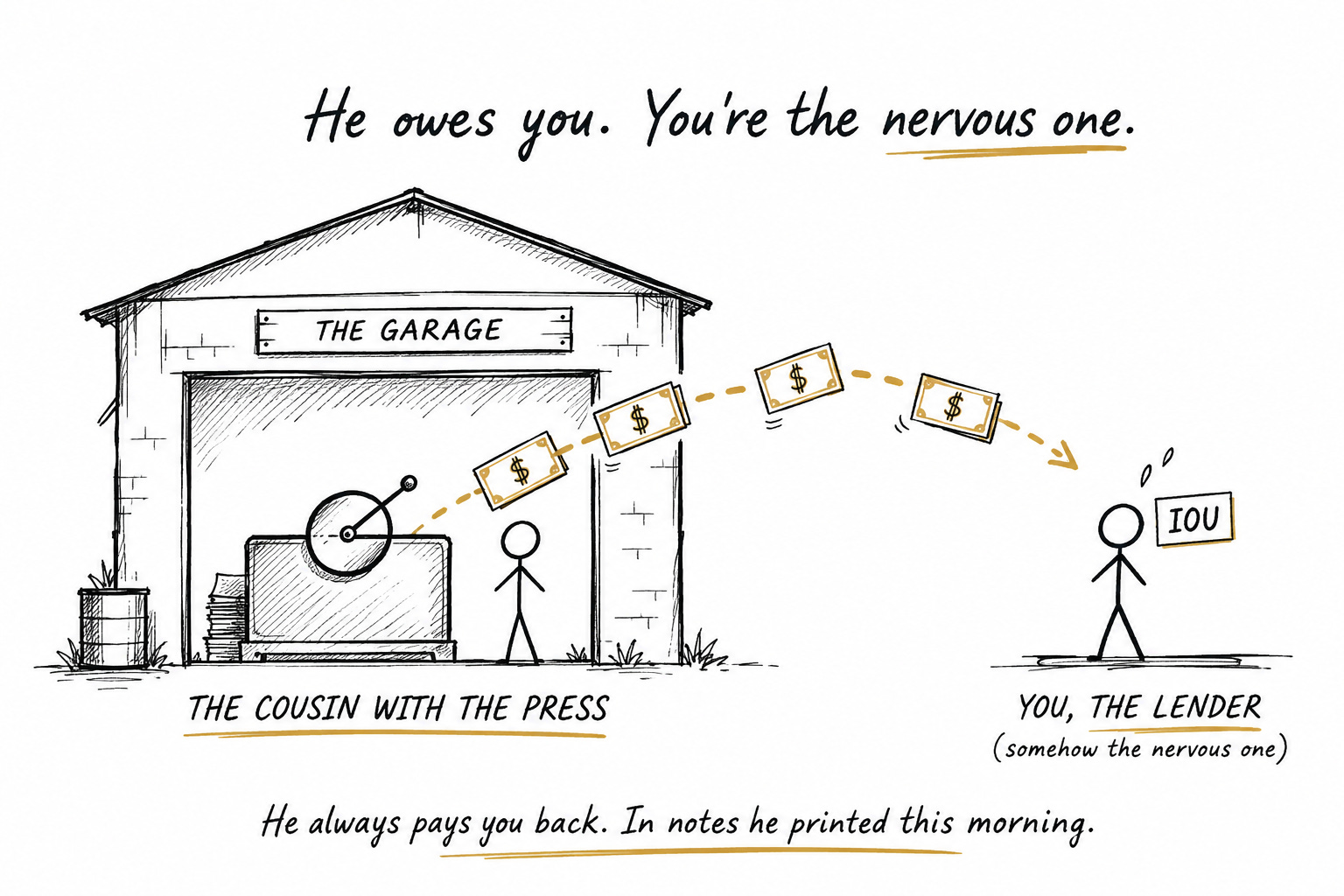
Now change one thing. Imagine your cousin could print the money he owes you, on a machine in his garage, whenever he liked. He would always pay you back, every last note. The notes might just buy a bit less by the time they reached you. And you’d take them anyway, because the whole town runs on his notes.
That isn’t a riddle. It’s roughly how the world has lived with America since 1971.
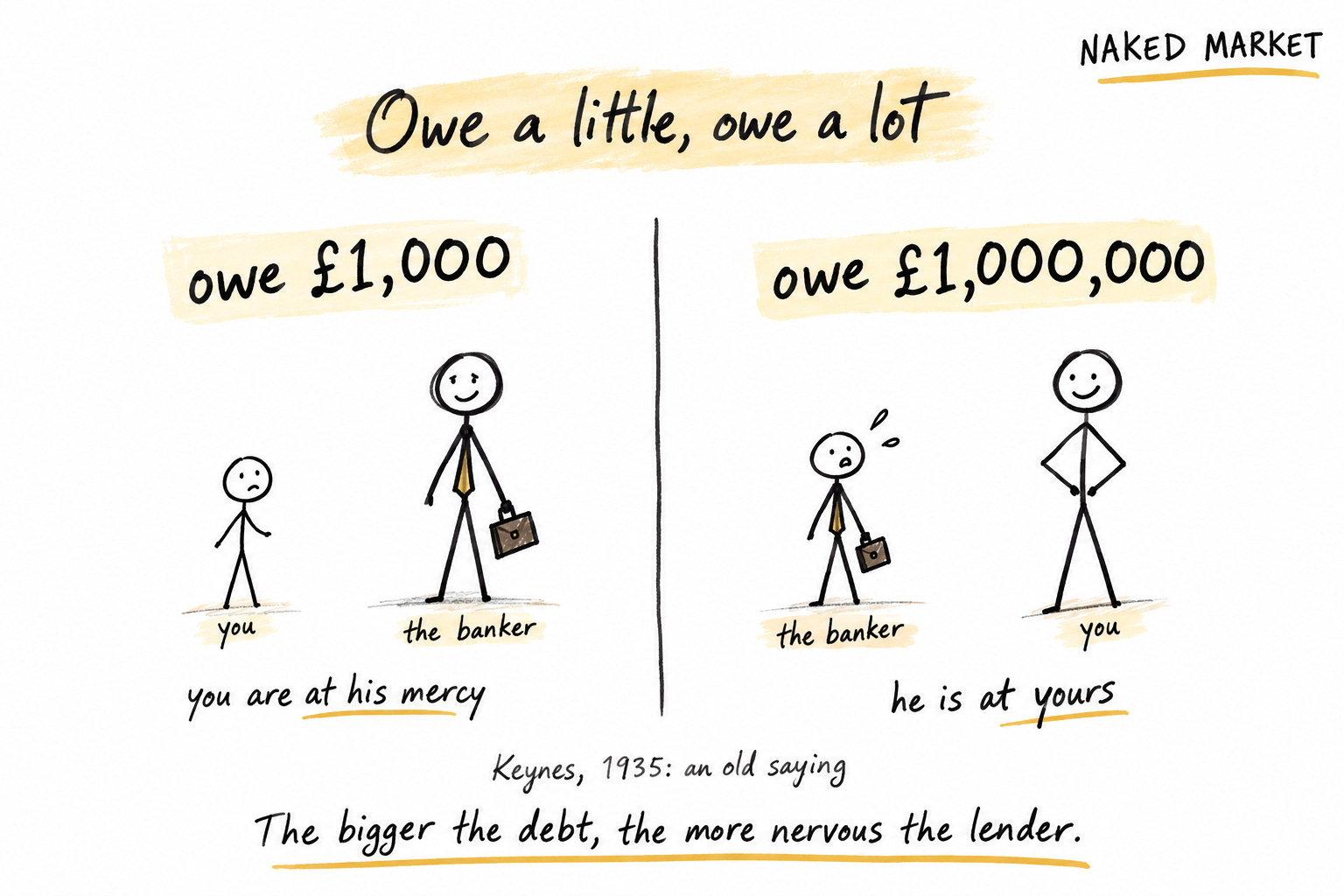
John Maynard Keynes, the economist you met in Part 4, understood this before almost anyone. In May 1945, a few months before he crossed the Atlantic to ask America for money, he wrote two sentences into a memo for Britain’s War Cabinet. He called the second one an old saying.
“The very size of these sterling debts is itself a protection. Owe your banker £1,000 and you are at his mercy; owe him £1 million and the position is reversed.”
John Maynard Keynes, memo to the War Cabinet, 15 May 1945
He thought he was writing about Britain. He was describing the next eighty years.
In 1971 an American Treasury Secretary named John Connally put the same idea much more bluntly. He was talking to a room full of European finance ministers who were worried about their money. The line is famous, and like a lot of famous lines it reaches us secondhand, so treat the exact wording with some care. The meaning isn’t in doubt.
The dollar is our currency, but it’s your problem.
John Connally, US Treasury Secretary, reportedly, 1971
That sentence is this whole issue. And wherever you’re reading this, Lagos or Lima, Jakarta or Johannesburg, Mumbai or Manchester, you live on the “your problem” side of it. If you’re reading in America, you’re on the other side of the table. We’ll get to why that seat is less comfortable than it looks.
No finance background needed. If you’ve ever been the nervous lender, or known the cousin with the garage, you already understand how this ends. The rest is how it got built, one decision at a time, over sixty years.
Grow with me.
2. THE PROMISE
As good as gold
If I handed you a piece of paper and told you it was as good as gold, what would you ask me?
Probably one thing. Do you actually have the gold?
In 1945 America could say yes, and mean it.
The war had wrecked nearly every other rich country. Europe’s cities were rubble. Japan was flattened. Britain, as you saw last time, was broke and borrowing. America was the only big economy left standing, untouched at home, its factories running day and night. It held around two thirds of all the gold that governments owned anywhere on Earth.
So when the winning countries met at Bretton Woods in 1944 to design the postwar money system, they put America in the middle. Part 4 told you how that argument went. Keynes wanted a new world money that no single country owned. Harry Dexter White wanted the dollar. White won, because America had the gold and everyone else needed it.
Here’s the deal they signed, in plain words.
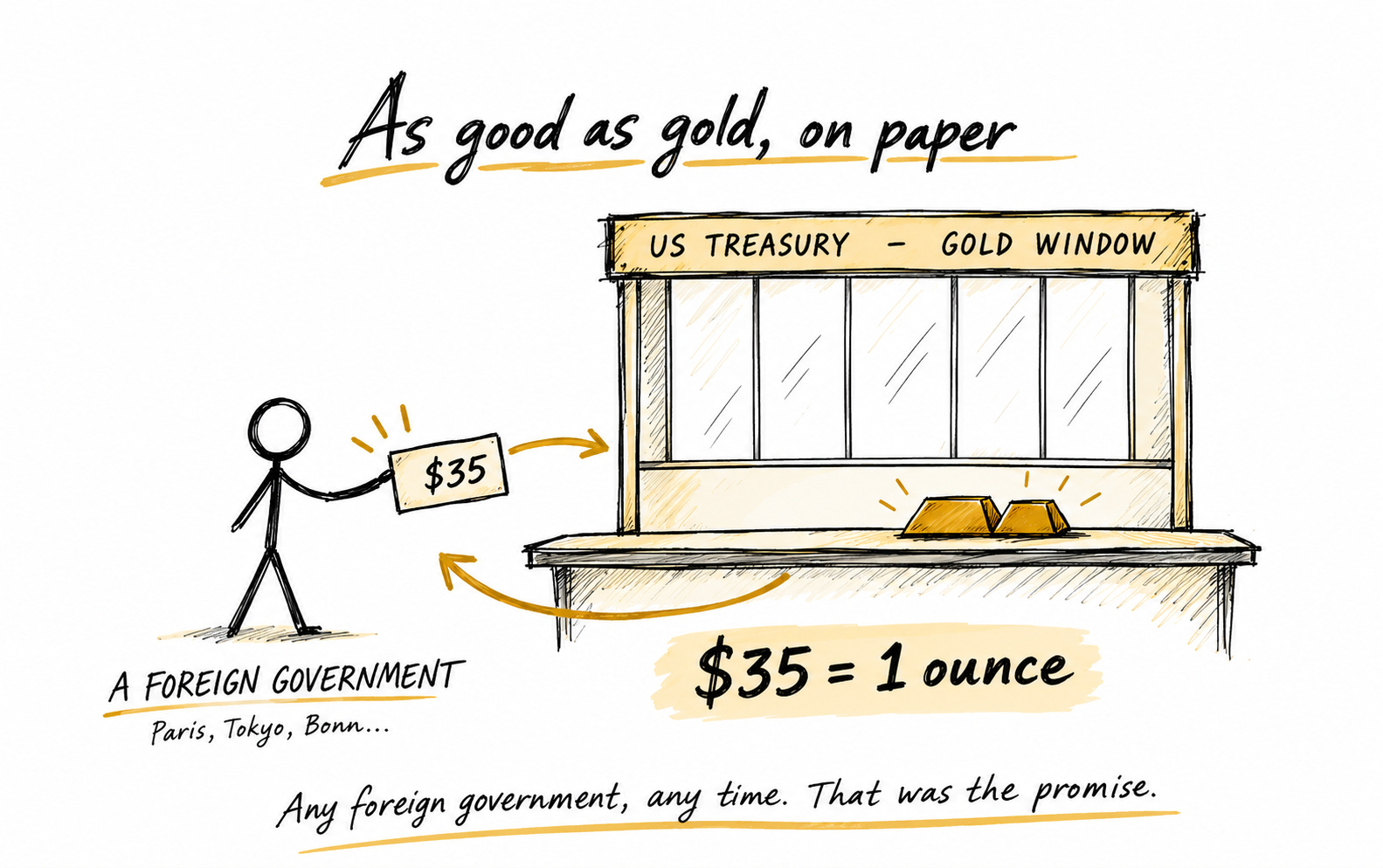
The dollar was tied to gold at a fixed price, thirty-five dollars for one ounce. Every other major currency was tied to the dollar. And any foreign government holding dollars could go to the American Treasury and swap them for gold at that price. Any time.
That last part was the promise. It’s what made the dollar more than American paper. A dollar in the vault of the Bank of France or the Bank of Japan was, in effect, a gold certificate America had sworn to cash.
It’s worth being fair here, because this part of the story is not a con.
America did not just sit on its gold. Between 1948 and 1952 it gave more than 13 billion dollars through the Marshall Plan to rebuild Western Europe. That’s well over a hundred billion in today’s money. It helped rebuild Japan. It opened its own markets to goods from countries it had just been fighting. You can argue about the motives, and people do. Fear of communism was a big one. But very few winners in history have spent that much putting their rivals back on their feet.
Most of the people who built this system believed they were doing something good. Many of them were.
And for about fifteen years it worked beautifully. Europe and Japan grew at speeds nobody had seen before. Trade exploded. The dollar was the water everything grew in.
3. THE OVERDRAFT
More tickets than coats
Picture the coat check at a big party.
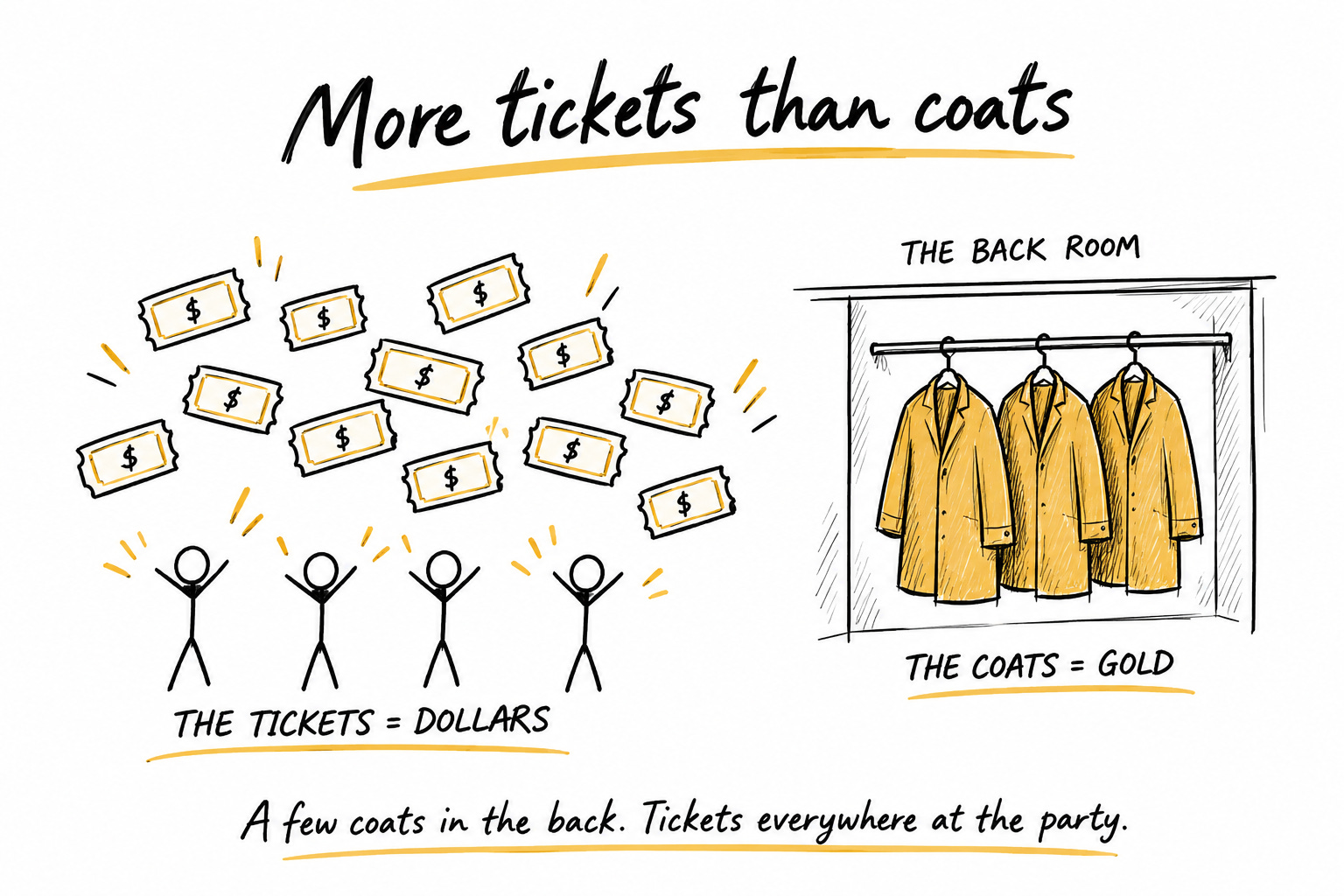
You hand over your coat and get a ticket, and the ticket is as good as the coat. Nobody worries, because there’s a coat for every ticket.
Now imagine the party keeps growing, and the guests start using the coat tickets as money. They pay for drinks with them. They settle bets with them. The tickets become so handy that everyone wants more. So the coat check starts handing out more tickets than it has coats.
For a while, nobody notices. Nobody wants their coat. They want the tickets.
That was the dollar in the 1950s and 1960s.
The world economy was growing fast, and growth needs money. Countries trading with each other needed dollars to do it. The only way the world could get more dollars was for America to send them out. It did that by spending abroad: aid, army bases in Germany, Japan and Korea, investment, imports. Later came two very expensive things at once. A war in Vietnam, and a huge spending programme at home that President Johnson called the Great Society.
Dollars poured out. The gold in the American vault didn’t grow to match.
By around 1960, foreigners were holding more dollars than America had gold to cover. That autumn, gold in London briefly traded at 40 dollars an ounce while the official American price was still 35. The market was saying, quietly, that it didn’t quite believe the promise.
A Belgian economist working in America, Robert Triffin, had seen it coming. He warned Congress in 1959 and put it in a book the next year with a blunt title, Gold and the Dollar Crisis. His point was simple, and it has never gone away.
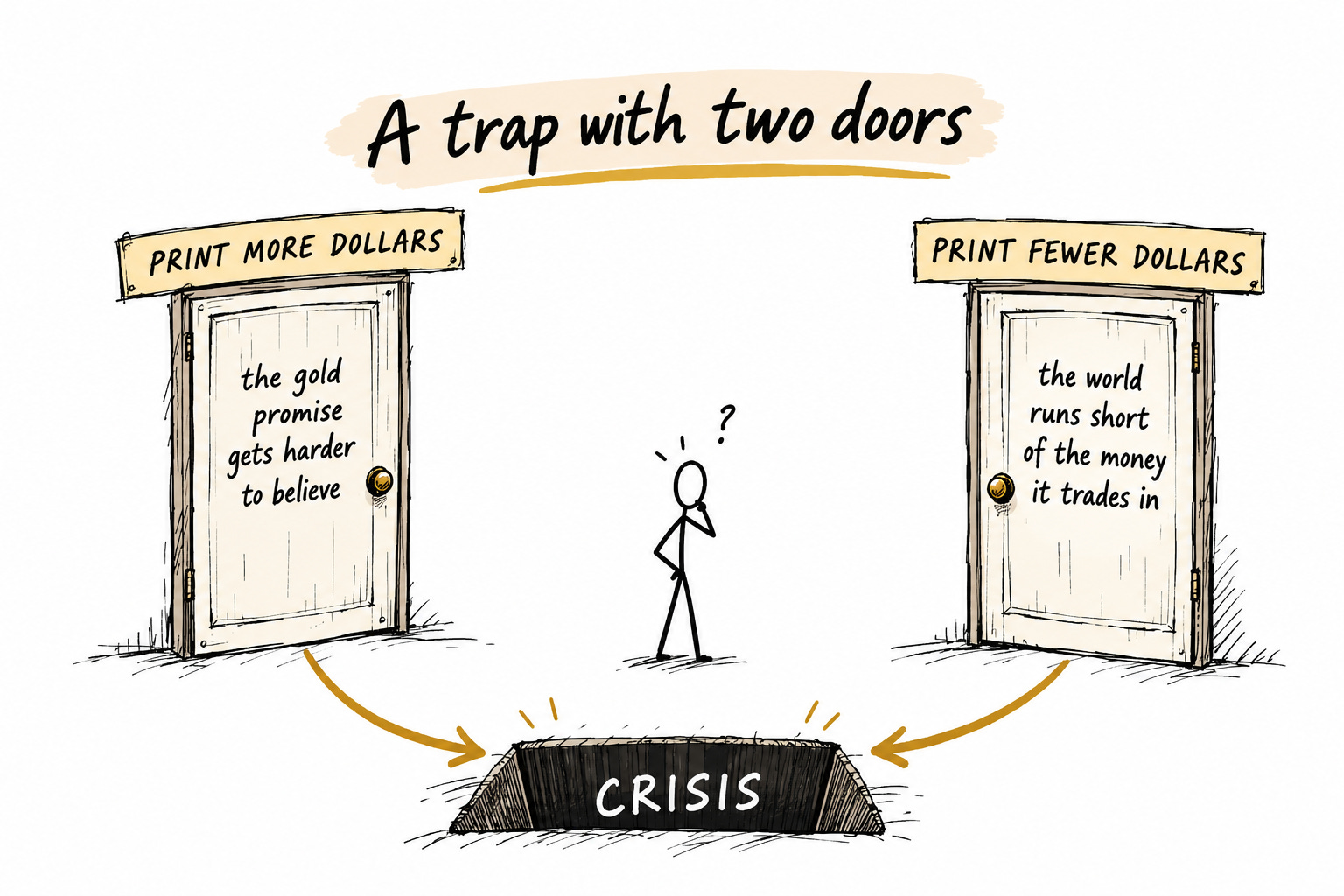
The system needed two things that pulled against each other. The world needed more and more dollars to grow. But every extra dollar abroad made the gold promise a little less believable. Keep supplying dollars, and one day nobody trusts the gold. Stop supplying them, and the world economy chokes. Triffin put it as a clash between liquidity and confidence. You couldn’t keep both forever.
The very thing that made the dollar useful, that everyone wanted it, was slowly eating its promise.
So why didn’t anyone fix it? They tried. From 1961, eight governments pooled their gold in London and sold it whenever the price crept above 35, to keep things looking steady. It was called the London Gold Pool. It collapsed in March 1968.
By the end of the decade, the coat check had several tickets out for every coat in the back room.
And one guest had quietly started asking for his coat.
4. VIDE-GOUSSET
Empty pocket
There’s a story you may have heard about Charles de Gaulle.
In the mid-1960s, the story goes, the French president got so fed up with the dollar that he sent a warship to New York. Its job was to bring France’s gold home. It’s a great story. It turns up in books, in articles, even on Wikipedia.
It isn’t quite true. The real version is better.
Myth
De Gaulle sent the French navy to New York to bring France’s gold home.
Record
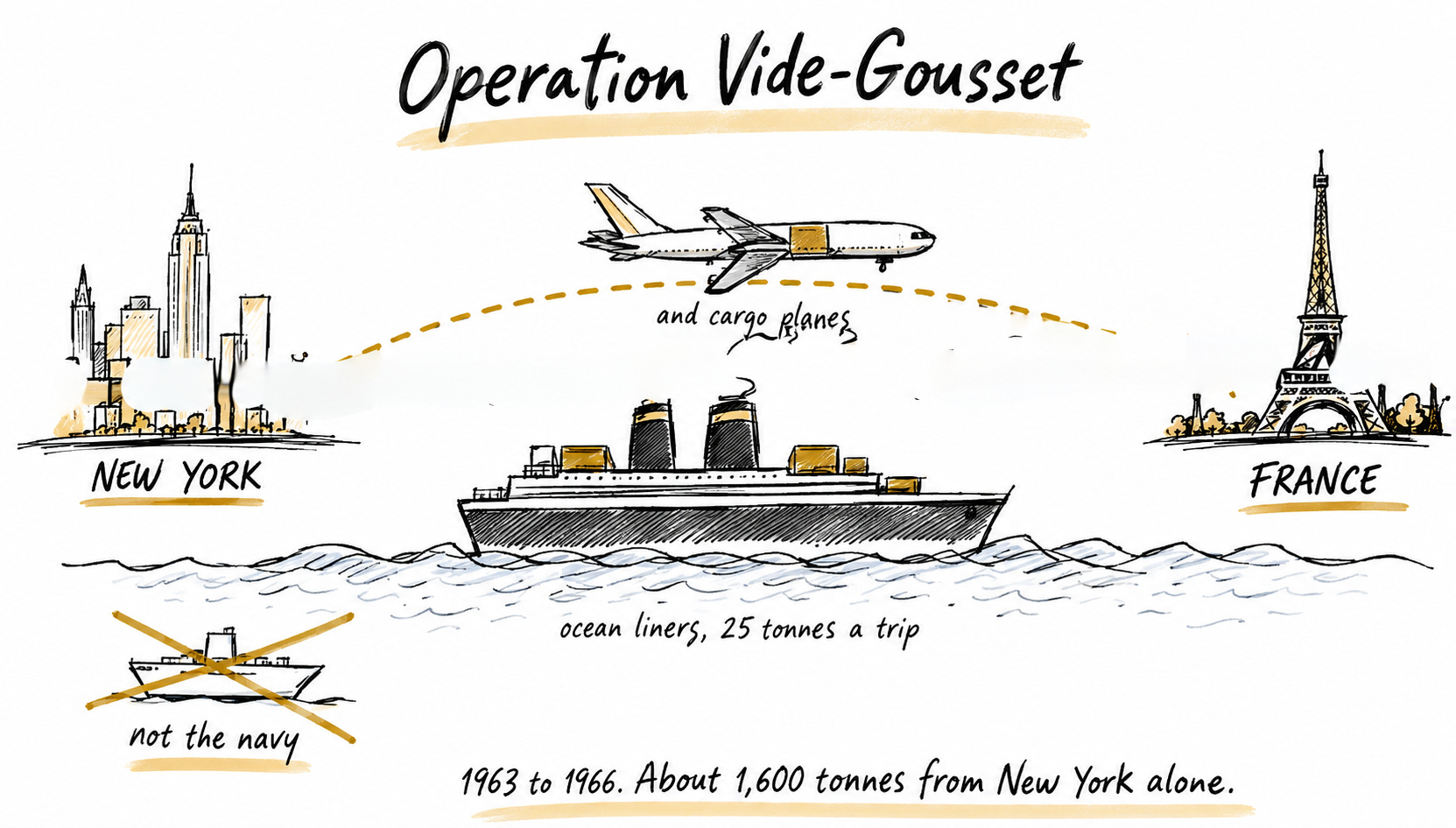
Using the navy was considered and rejected, because it would have blown the secret. France used ocean liners and Air France planes instead, in an operation code-named Vide-Gousset. Empty pocket.
Between 1963 and 1966, France quietly swapped its dollars for American gold and shipped it home. Later research drawing on French central bank sources puts the total from New York alone at about 1,600 tonnes. It crossed the Atlantic 25 tonnes at a time on passenger liners, with more flown out on cargo planes.
Why go to all that trouble?
Because de Gaulle had worked out the trick. At a press conference in Paris on 4 February 1965, he said it out loud. The United States could go into debt to other countries for free, he argued, because it paid them, at least in part, in dollars only America could create. He wanted the world to go back to gold, a money that bore the mark of no particular country.
His finance minister, Valéry Giscard d’Estaing, had already given the arrangement the name it still carries. He called it America’s exorbitant privilege. You’ll often see that phrase credited to de Gaulle. It was Giscard’s. Either way, the point was the same. Every other country had to earn its dollars by selling things to the world. America could simply make them.
So France did the one thing a nervous lender can do. It asked for its coat back.
Other countries followed, more quietly. By the summer of 1971 the line at the gold window was long, and someone in Washington had to decide what to do about it.
5. 15 AUGUST 1971
Sunday night
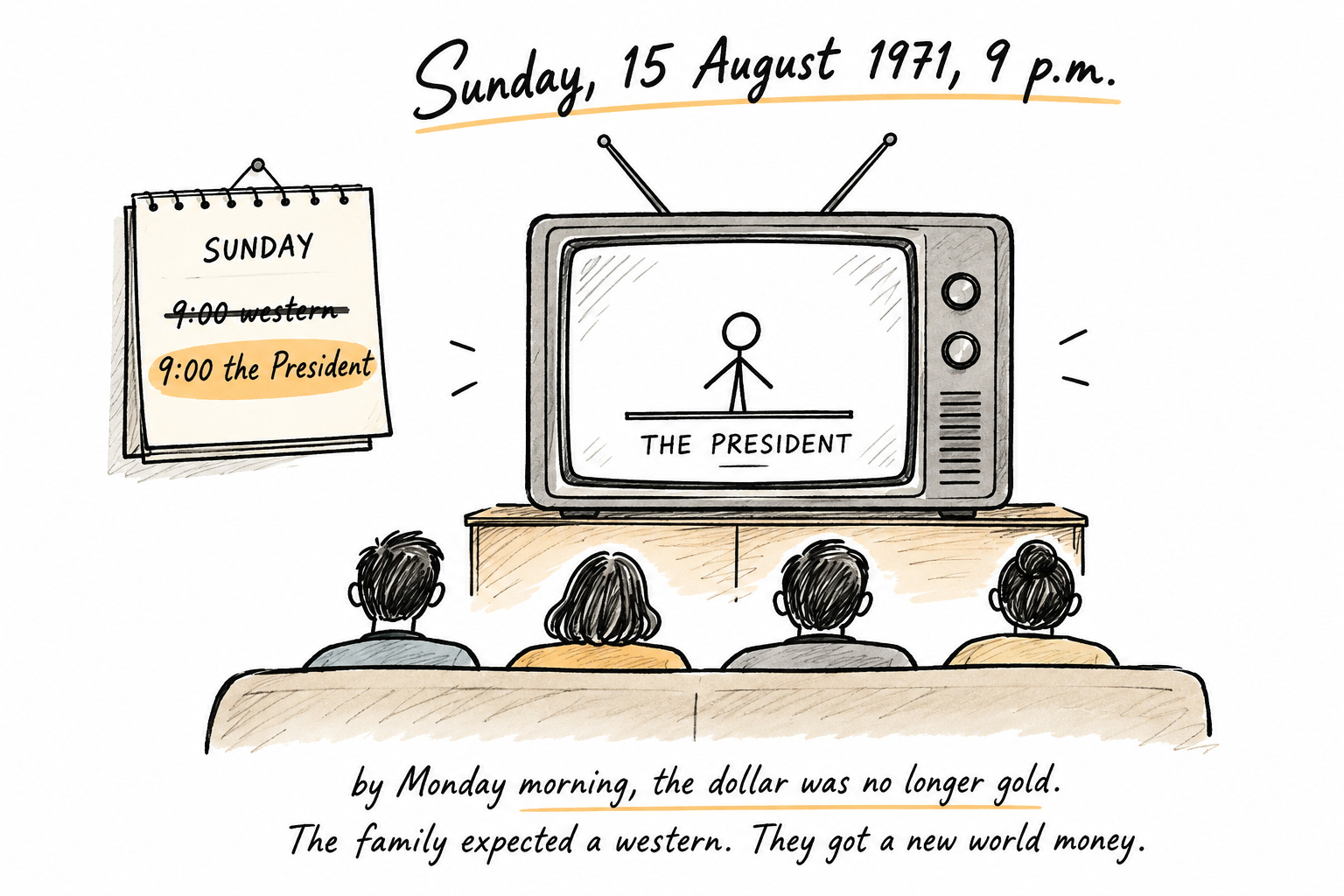
Sunday 15 August 1971. Nine o’clock in the evening, on America’s east coast.
Across the country, families are settling in front of the television for Bonanza, one of the most popular shows of the time.
Instead, the President appears.
Richard Nixon has just come back from a secret weekend at Camp David, the presidential retreat in the Maryland hills. Since Friday afternoon he has been shut away there with fifteen advisers. His Treasury Secretary, John Connally. The head of the Federal Reserve, Arthur Burns. And a tall, quiet Treasury official named Paul Volcker. You’ll meet Volcker again. Eight years from now, his decisions will land on kitchen tables in Mexico City.
His Secretary of State wasn’t there, and wasn’t consulted. Henry Kissinger, his national security adviser, was away and wasn’t consulted either. One of the biggest foreign policy decisions of the century was made by the people who ran the money. The people who ran foreign policy found out with everyone else.
What pushed them over the edge that week is still argued about. By most accounts, Britain, of all countries, came to the American Treasury asking to protect its dollar holdings. Whether the British wanted actual gold or only a guarantee is disputed to this day. Volcker’s reading of it was blunt. If even the British were going to take gold for their dollars, the game was over.
So on Sunday night Nixon told the country, and without quite meaning to, the world.
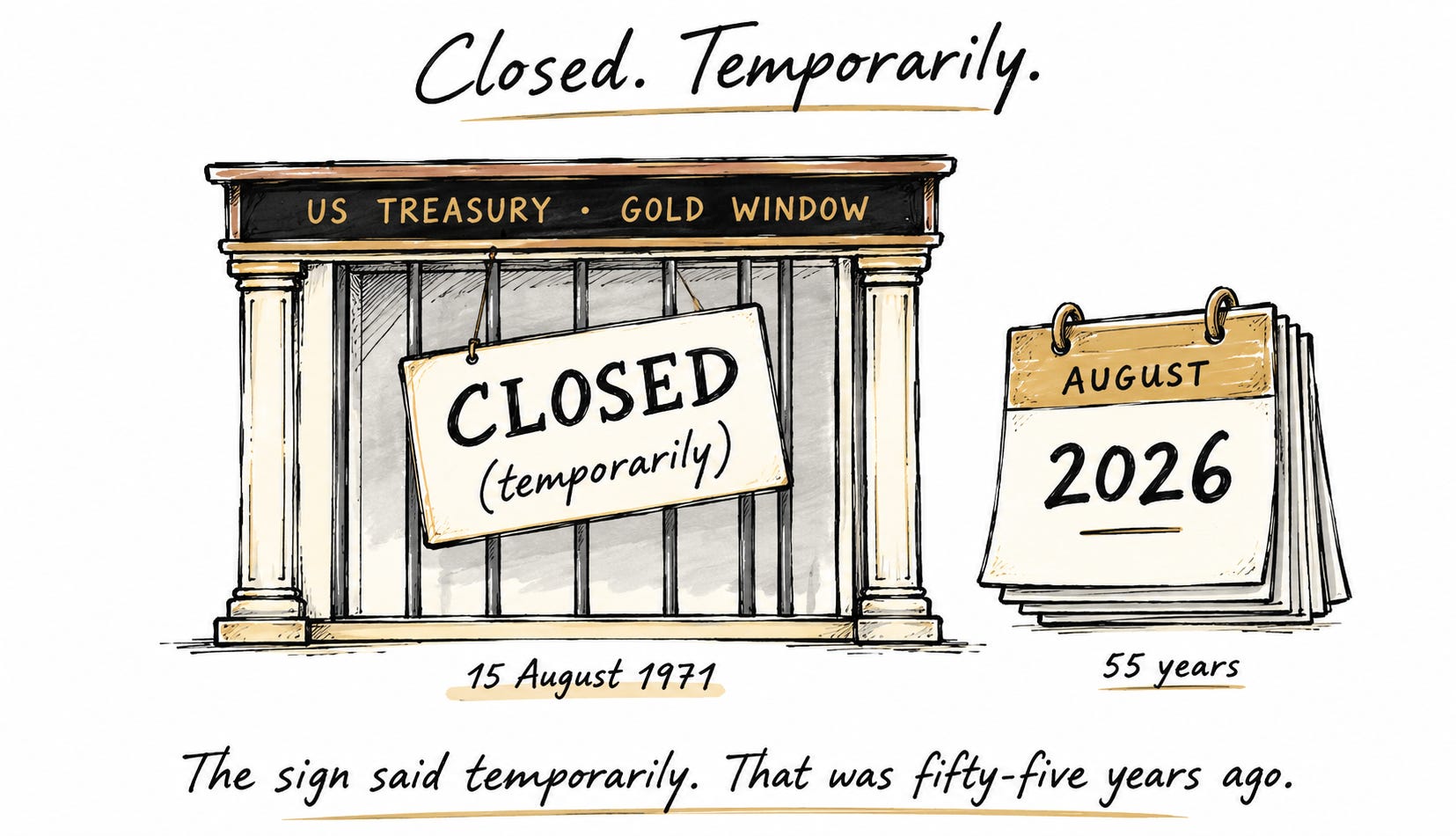
“I have directed Secretary Connally to suspend temporarily the convertibility of the dollar into gold or other reserve assets.”
Richard Nixon, address to the nation, 15 August 1971
Temporarily.
How long did temporarily last? Fifty-five years, so far. The window was closed on a Sunday night, while the markets were asleep, and it has never reopened.
He announced other things too. A 90-day freeze on wages and prices. A 10 percent charge on imports. And he blamed the whole mess on “international money speculators,” who, as he put it, “thrive on crises.”
Then came the sentence that, to my ear, explains everything that followed.
“If you want to buy a foreign car or take a trip abroad, market conditions may cause your dollar to buy slightly less. But if you are among the overwhelming majority of Americans who buy American-made products in America, your dollar will be worth just as much tomorrow as it is today.”
Richard Nixon, same speech
Read that as a foreigner would. Who carries the cost? People buying foreign things, and foreigners. Americans at home would be fine.
A dollar from that night, by the way, now buys about an eighth of what it bought then. If you want to know where the other seven eighths went, I broke that down in what inflation really is, in three minutes.
On Monday the Dow jumped 33 points, its biggest one-day gain ever at that point. Americans took it as good news.
Abroad, it was chaos. Europe shut its currency markets. Japan made a choice that shows you exactly where the rest of the world stood. It kept its market open for two weeks and kept buying dollars at the old fixed price of 360 yen, to protect its exporters. By the time it stopped, it had bought dollars worth about half of its national reserves. It was paying full price for a promise America had already torn up.
Later that year, Connally sat across from those worried European finance ministers. By the best-known account of the meeting, he told them the dollar was America’s currency but their problem.
He wasn’t wrong.
6. THE TRICK
Why the dollar didn’t die
Here’s what you’d expect to happen next.
America had just broken the central promise of the world’s money. The dollar was no longer a gold certificate. It was paper backed by America’s word, and America had just shown what its word was worth once keeping it got expensive.
Governments did try to patch things up. In December 1971 they agreed a new set of fixed rates at the Smithsonian Institution in Washington, and Nixon called it “the most significant monetary agreement in the history of the world.” It lasted about fifteen months. By March 1973 the big currencies were floating, their prices set by markets every day, and the link to gold was gone for good.
So the world walks away. Right?
It didn’t. It moved closer.
This is the part most explanations rush past, and it’s the most important part of the story. There were three reasons the world stayed, and you already know the first one from the cousin with the garage.
The debts were in dollars. Central banks everywhere were sitting on piles of American money. Suppose you hold a mountain of dollars. What happens if you start dumping them? The dollar falls, and the mountain you’re still holding is worth less. You’d be setting fire to your own savings to punish America. So you don’t. You hold on, and you hope, and you stay polite. The lender becomes the nervous one.
There was nowhere else to go. In Part 3 we talked about the settlement moat. Everyone uses the keeper’s money because everyone uses the keeper’s money. Trade was priced in dollars. Loans were written in dollars. Shipping, insurance, oil, wheat, metals, all in dollars. You can’t leave that network on your own, any more than you can quit WhatsApp alone and still talk to your family.
The third reason hadn’t arrived yet. It came three years later, in the desert, and it’s the next chapter.
First, back to Keynes, because this is where his memo clicks into place.
In 1945 Britain owed huge sums to India, Egypt and the other countries of its empire, and it owed them in pounds. Keynes saw that this gave Britain a strange kind of power. The debts were so big, and so much in Britain’s own money, that the lenders were stuck with them. “The very size of these sterling debts is itself a protection.”
He was right, and Britain used that protection. When it devalued the pound in 1949, the value of what it owed India, measured in dollars, fell by about 30 percent overnight. India could do nothing about it. You saw that in Part 4.
But Britain could never use the trick on America. Its big American loan was in dollars. You can’t print your way out of a debt written in someone else’s money. You have to earn your way out. That’s why Britain was still paying America in 2006.
America owes the whole world in its own money.
Britain owed money it had to earn. America owes money it can print.
That one difference explains the puzzle from the start of this issue. America broke the rule that ruined Britain because America found the one exception to it.
The one who is owed gives the orders. Unless the one who owes also prints the money.
7. THE OIL
The deal in the desert
In October 1973, war broke out between Israel and its Arab neighbours. When America backed Israel, the Arab oil producers answered with an embargo. Within months the price of oil had roughly quadrupled.
If you were alive then, you remember the queues at petrol stations. If you weren’t, your parents or grandparents will. Economies all over the world that ran on cheap oil suddenly didn’t.
And in the Gulf, a flood of money began to pile up. The oil producers were earning dollars far faster than they could spend them.
In July 1974, America’s new Treasury Secretary, a former bond trader named William Simon, flew to Saudi Arabia with his deputy, Gerry Parsky. Officially it was economic diplomacy. What they agreed stayed secret for more than forty years, until Bloomberg News dug it out with a freedom-of-information request in 2016.
The shape of the deal was simple. America would buy Saudi oil and supply the kingdom with military aid and equipment. In return, the Saudis would put billions of their oil dollars back into American government bonds, helping to pay for America’s spending.
There was one more condition. The Saudi king, Faisal, wanted it kept, in the words of a diplomatic cable, “strictly secret.” So for 41 years the US Treasury never reported Saudi Arabia’s holdings on their own. It lumped them in with a group of fifteen oil-exporting countries. When the number finally came out in May 2016, the Saudis held 117 billion dollars of American debt.
Now follow the chain. Every country on Earth needs oil. And what was oil priced and paid for in? Dollars. So every country needed dollars. And the countries earning the most dollars from oil lent a large share of them straight back to America.
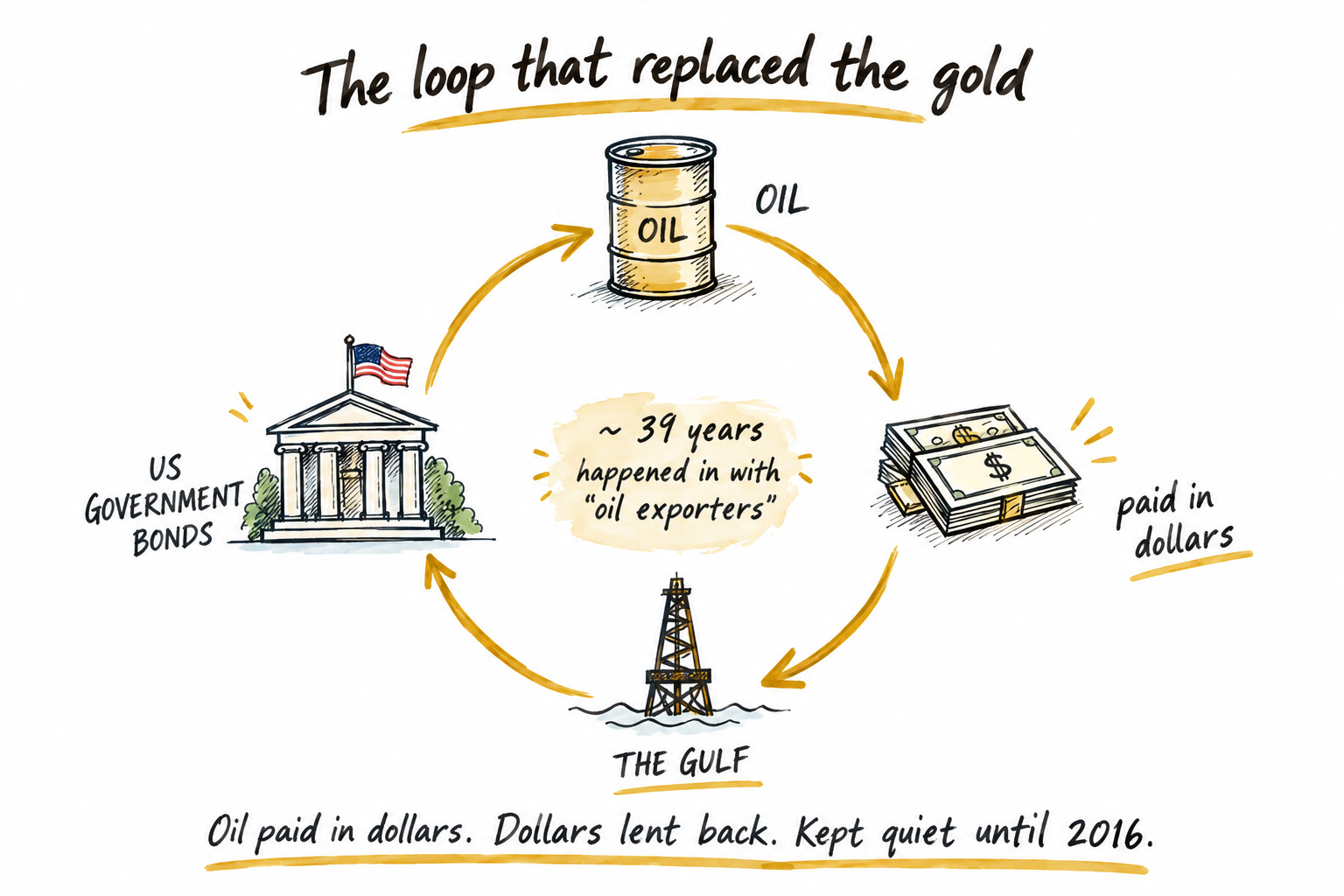
In 1971 the dollar lost its gold. By 1974 it had something that worked almost as well. Not a metal. A need.
People call this the petrodollar, and there’s a popular myth about it worth clearing up, because you’ve almost certainly seen it.
Myth
In 1974 America and Saudi Arabia signed a 50-year treaty promising to sell oil only in dollars, and it expired in June 2024.
Record
No such treaty existed. Fact-checkers found no written agreement requiring Saudi oil to be sold in dollars. The real 1974 deal was quieter: recycle the oil money into American debt, and keep it secret.
The truth is more interesting than the myth. America never needed a contract forcing anyone to use dollars. It only needed the money to come back.
I wrote about how oil and money wrap around each other in This War Was Never Really About Oil. This deal is where that loop was born.
8. WHO PAID
The bill arrives in Mexico City
August 1982. Washington.
Mexico’s finance minister, Jesús Silva Herzog, has a message for three men. The chairman of the Federal Reserve. The American Treasury Secretary. The head of the International Monetary Fund. Mexico can no longer pay its debts. About 80 billion dollars of them.
How does a country end up there? Follow the oil money.
All those dollars piling up in the Gulf in the 1970s had to go somewhere. A lot of them were deposited in big Western banks, and the banks lent them out again, above all to fast-growing countries in Latin America. Governments borrowed to build roads, dams and factories. Some of it was wise. Some of it was reckless, and some of it was stolen. Latin America’s foreign debt went from 29 billion dollars in 1970 to 327 billion by 1982.
Almost all of it was borrowed in dollars. And much of it was borrowed at interest rates that floated, rising and falling with interest rates in America.
That floating rate was the fuse. The match, when it came, was struck in Washington, for reasons that had nothing to do with Mexico.
By the late 1970s America had an inflation problem that wouldn’t go away. Prices were rising at double-digit rates. In 1979 President Carter made Paul Volcker chairman of the Federal Reserve, the same Volcker who had sat at Camp David in 1971. Volcker did the one thing that reliably kills inflation that bad, and it hurts. He squeezed. He pushed American interest rates up and up, until the Fed’s key rate hit a record 20 percent in late 1980. If you want the mechanics of how a central bank squeezes like that, I laid them out in How Central Banks Actually Control Liquidity.
It worked, for America. Inflation fell to under 4 percent by 1983. Volcker is remembered, fairly, as the man who broke American inflation. Americans paid for the cure too. The squeeze tipped the country into a deep recession, and unemployment hit 10.8 percent in late 1982. But it was America’s own medicine, prescribed by America’s own central bank for America’s own illness.
From Mexico City, it looked very different. Mexico got the side effects without ever being the patient.
Every rise in American rates raised the interest bill on those floating dollar loans. The debts didn’t shrink. The cost of carrying them exploded. At the same time the dollar got stronger, so every peso bought fewer of the dollars Mexico needed to pay. A decision made in Washington, for American reasons, landed on Mexico’s finance ministry like a falling wall.
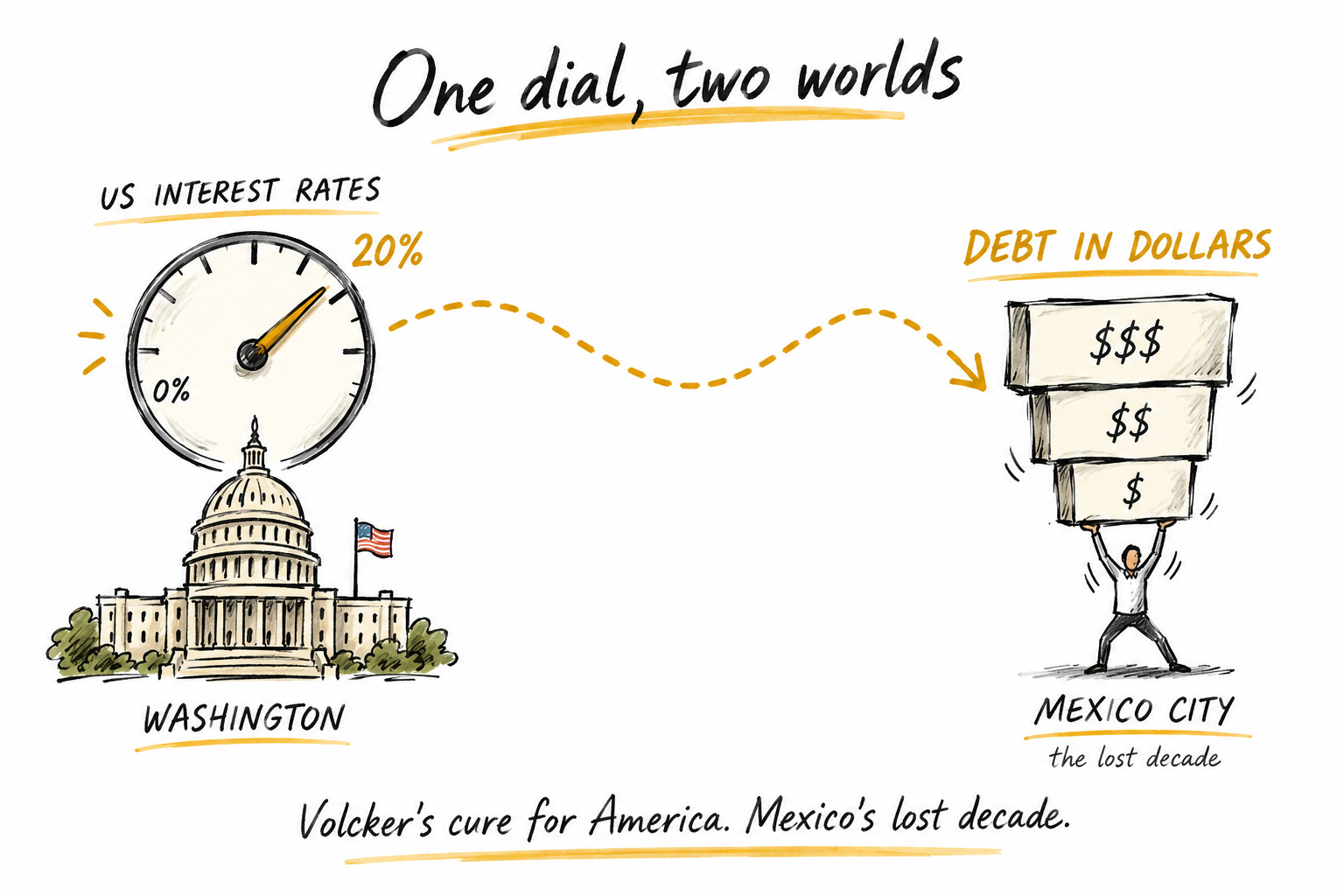
Mexico’s collapse set off a chain. Sixteen Latin American countries ended up rescheduling their debts. Across the region, the 1980s became known as the lost decade. Governments cut spending on health, schools and roads. Wages were frozen. Public workers were laid off. Incomes per person fell for years. In that episode, a basket of currencies from developing countries lost about 30 percent against the dollar. The Mexican peso lost about 80.
What does an 80 percent fall mean for an ordinary family? It means your savings, your salary and your pension are counted in a money that lost four fifths of its value. And your country’s debts are written in the one that didn’t. The shop prices keep rising. Your wage doesn’t.
Meanwhile, the nine biggest American banks were holding Latin American loans worth more than all of their capital put together. If those loans had simply been written off, some of America’s largest banks would have been in serious danger. So the debts weren’t written off. They were stretched, rescheduled, and squeezed out of the borrowers for most of a decade. Only with the Brady Plan, from 1989, did the lenders finally forgive about a third of what was owed.
It’s fair to say the Latin American governments made real mistakes. They borrowed too much, too fast, and some of that money vanished into private pockets. Both things are true.
But notice who set the price of those mistakes. Not Mexico City. Washington.
Our currency. Your problem.
9. 1985
The borrower who gives orders
In June 1985 the American Commerce Secretary, Malcolm Baldrige, made an announcement that sounded like dull accounting. America now owed foreigners more than foreigners owed America. The Washington Post called it a dubious distinction the country had not had since 1914.
Since 1914.
If you read Part 4, you’ll recognise that year. 1914 is when Britain and America swapped seats. It’s where Britain began the long walk from lender to borrower. That walk ended at Suez, with the British Empire turning its army around because America’s money told it to.
In 1985 America took the same step, the other way. It became a borrower nation again.
And nothing happened.
No run on the dollar. No humiliating trip to ask for help. No Suez.
In fact, three months later, America did something that turned Part 4’s rule upside down. In September 1985, at the Plaza Hotel in New York, it sat down with Japan, West Germany, France and Britain. Together they agreed to push the dollar down. The key partner in that deal was Japan, which had just become the largest creditor nation in the world. Japan went along, under heavy American pressure over trade, and over the next two years the yen climbed steeply against the dollar.
The world’s biggest lender did what the world’s biggest borrower needed.
The creditor took the order.
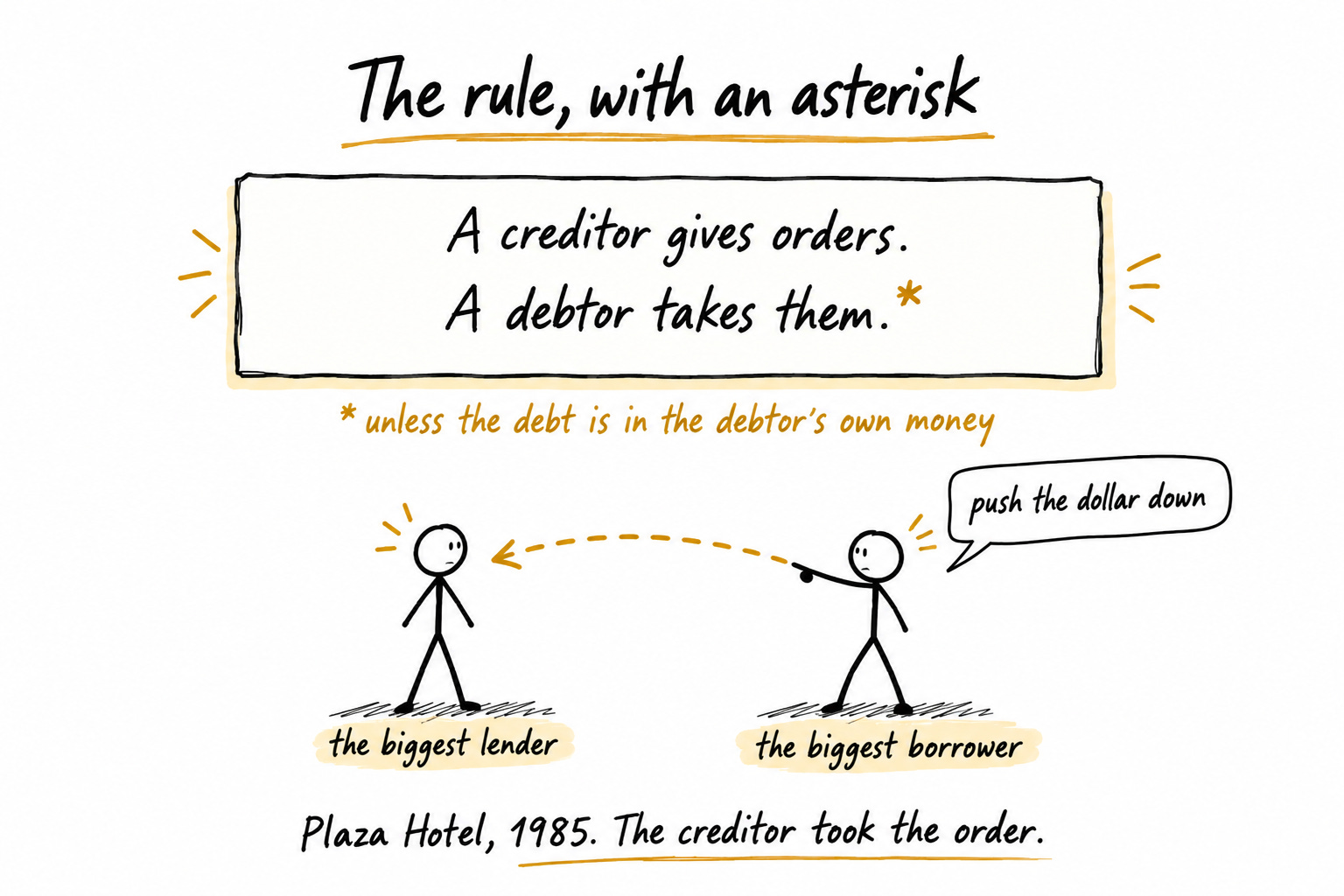
Part 4 said a creditor gives orders and a debtor takes them. That’s true almost everywhere, almost always. It was true for Britain. It’s true for most countries, most companies and most people.
It stopped being true for America because of the exception you now know. When your debts are in your own money, and the whole world needs that money, your lenders aren’t really your creditors anymore. They’re closer to hostages. Polite, well-paid hostages. But hostages.
10. SEOUL AND JAKARTA
Wedding rings
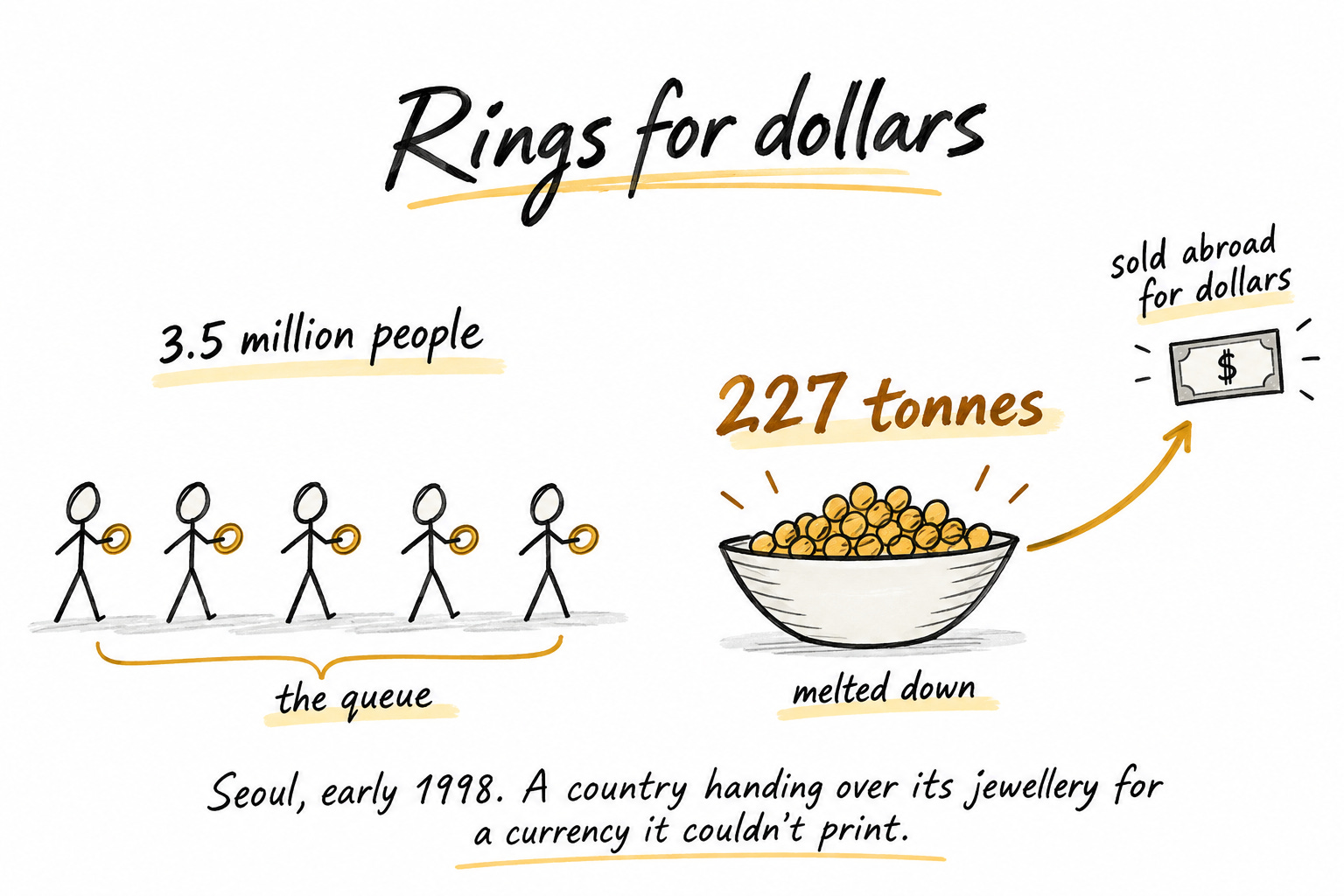
In the first months of 1998, about three and a half million people in South Korea queued up to hand over their gold.
Wedding rings. Necklaces. Family heirlooms. People brought whatever they had, and it was melted down and sold abroad for dollars. By the end of April the campaign had collected around 227 tonnes, worth about 2.1 billion dollars.
Why would a whole country empty its jewellery boxes?
Because at the end of 1997, South Korea had run out of dollars.
It started in Thailand. On 2 July 1997, after burning through billions trying to defend its currency, Thailand let the baht float, and it sank. The foreign money that had poured into Asia during the boom turned and ran. Country after country found itself in the same trap. Their banks and companies had borrowed in dollars, but they earned in baht, rupiah and won. When those currencies fell, the dollar debts swelled. Between July 1997 and January 1998, the Korean won lost about half its value. The Indonesian rupiah lost about 80 percent.
So they went to the IMF. On 3 December 1997, South Korea signed up for a 57 billion dollar rescue, the largest ever at the time. Indonesia had already been promised 40 billion. The money came with conditions: raise interest rates, cut budgets, close banks, open up to foreign buyers, break up favoured monopolies.
There’s a photograph from that winter that many Indonesians still remember.
On 15 January 1998, President Suharto, who had ruled Indonesia for three decades, sat at a table and signed a new agreement with the IMF. Standing behind him, arms folded, was the head of the IMF, Michel Camdessus. To millions of people the picture said one thing: the most powerful man in the country, signing where he was told.
In fairness, the World Bank’s own director for Indonesia later defended him. Camdessus, he wrote, had simply stood where he was asked to stand, and he folds his arms out of habit. Maybe so. But a photograph doesn’t care what you meant. People saw what they saw.
Within about a year, the share of Indonesians living in poverty more than doubled. Before the crisis it was around 7 or 8 percent. By late 1998 it was somewhere between 18 and 20. There were riots. In May 1998, Suharto resigned.
This order of events should feel familiar from Part 4. Britain at Suez in 1956: first you do what you’re told, then the money arrives. Same machine, new customers.
The ending isn’t simple, and it’s worth being honest about it. South Korea bounced back fast. It repaid its IMF loans in August 2001, three years early, and some of the reforms left its economy stronger. But the lesson the whole region took away wasn’t the one the IMF intended.
The lesson was: never, ever run out of dollars again.
11. UPHILL
Money flowing uphill
Put yourself in the chair of a central banker in Asia in 1998.
You’ve just watched your currency collapse. You’ve watched a president sign away economic policy to get a loan. You’ve watched people queue with their wedding rings. What do you promise yourself?
Never again.
And the only way to keep that promise was to build a wall of dollars so high that you’d never need anyone’s rescue. So that’s what they did. Across Asia, and later across the oil states, central banks piled up dollar reserves on a scale the world had never seen. China most of all.
And where do you keep a mountain of dollars safe? You lend it back to America, in American government bonds.
That meant something strange. Countries with millions of their own people still poor were lending their savings to the richest country on Earth. Money was flowing uphill.
In March 2005, a Federal Reserve governor who would soon run the Fed, Ben Bernanke, gave a speech about exactly this. He called it a “global saving glut.” After the crisis of 1997 and 1998, he pointed out, developing countries in Asia had switched from borrowing from the world to lending to it. A lot of that lending ended up in America. Then he said, very politely, that this was backwards.
“For the developing world to be lending large sums on net to the mature industrial economies is quite undesirable as a long-run proposition.”
Ben Bernanke, speech, 10 March 2005
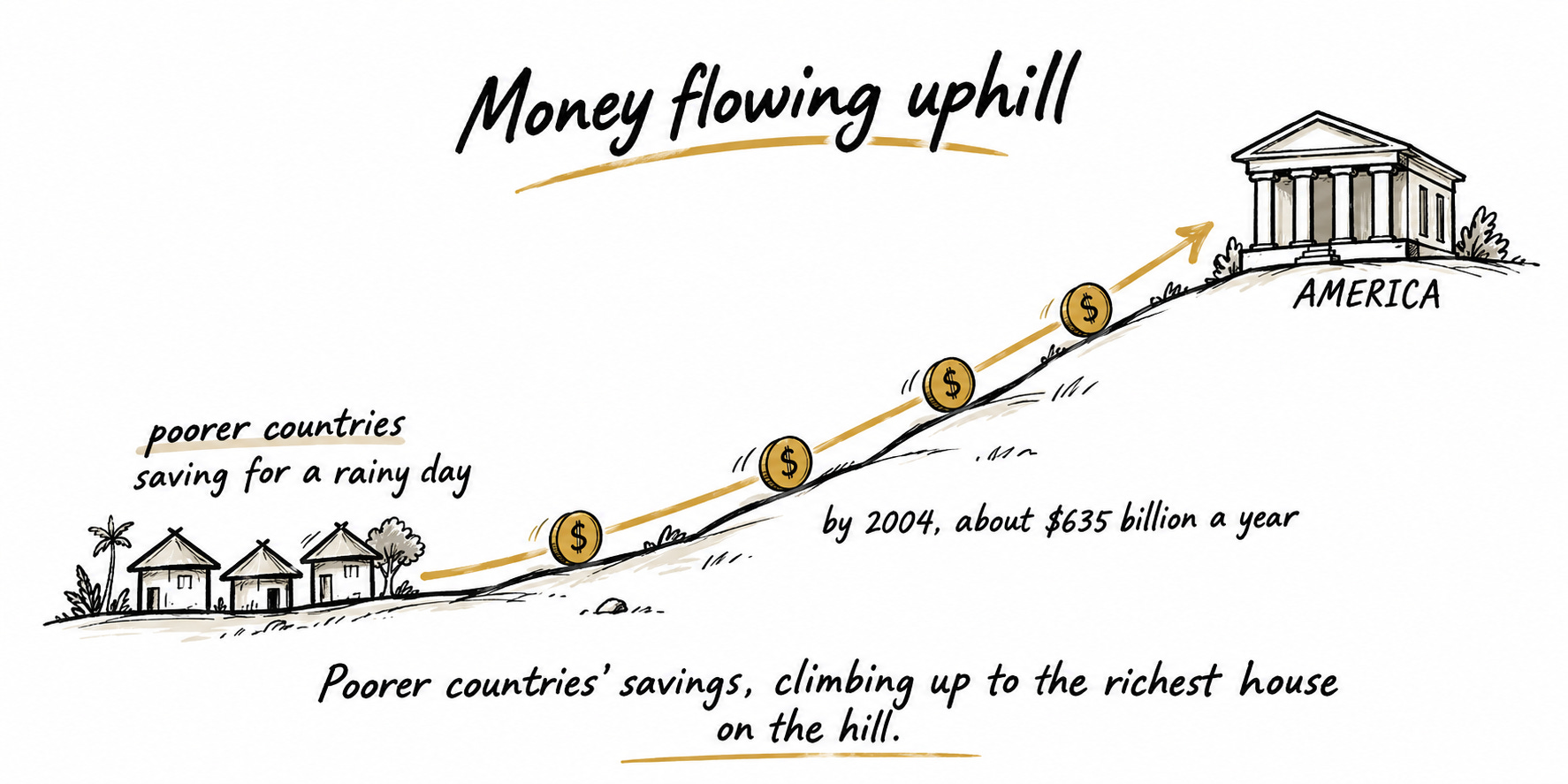
All that foreign money helped push American interest rates down. Cheap money went looking for something to buy, and a lot of it found American houses and the mortgages behind them. By late 2004 America was borrowing about 635 billion dollars a year from the rest of the world. That’s roughly five and a half percent of its whole economy, and the world was happy to lend it.
So here’s the loop. America raised its rates in 1979 and crushed Latin America. The rescue system America dominated saved Asia in 1998, on its own terms. Asia swore never again and stockpiled dollars. Those dollars flowed back to America and helped pump up a housing bubble. In 2008 it burst.
12. 2008
Everyone ran into the burning house
Monday 15 September 2008.
Lehman Brothers, an American bank that had been around for 158 years, files for bankruptcy. Within days the whole financial system freezes. Banks stop lending to each other. The crisis was built in America, on American mortgages, packaged by American banks and sold all over the world.
If there was ever a moment for the world to finally walk away from the dollar, this was it.
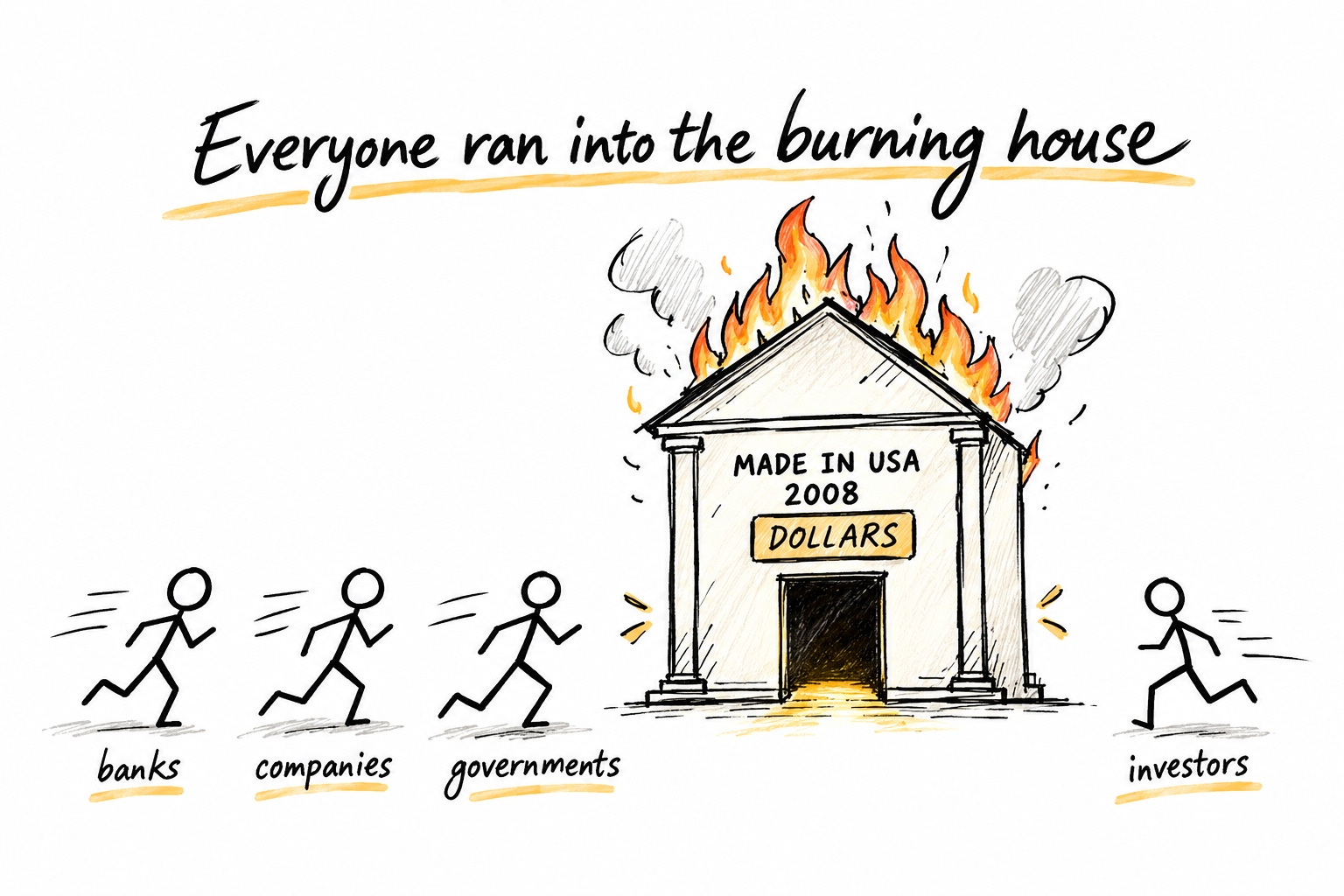
Instead, it ran toward it.
Money poured into the dollar and into American government bonds. Most currencies on Earth fell against the dollar in 2008. Only a couple of other safe havens, like the Japanese yen and the Swiss franc, held up. The house on fire was American, and everyone ran inside.
Why on earth would anyone do that?
Because the whole world had borrowed in dollars. European banks, Asian companies, Latin American governments. When the panic hit, they all needed dollars at the same moment, to pay what they owed. And only one place on the planet can create dollars without limit.
So the Federal Reserve became something it was never built to be: the emergency lender to the entire world.
It did it through what are called swap lines. Put simply, the Fed lent other central banks dollars and took their own currency as security. Fourteen central banks got them. By 17 December 2008, 583 billion dollars was out on loan this way. For the European Central Bank, the Swiss, the Bank of England and the Bank of Japan, there was no limit at all.
On 29 October 2008 the Fed added four more: Brazil, Mexico, South Korea and Singapore, up to 30 billion dollars each. Its announcement said the lines were meant for “fundamentally sound and well managed economies.”
Who decided which economies counted as fundamentally sound?
Not the IMF. Not a vote of the world’s nations. A committee in Washington.
India didn’t get a line. Neither did Indonesia, or Turkey, or South Africa. The Fed wasn’t being cruel. Its job is to protect the American financial system, and it picked countries big enough, and connected enough, for their trouble to wash back onto America. But it meant that in the worst weeks in eighty years, whether your country could get emergency dollars depended on whether Washington thought it mattered.
Back in Part 3 we said that “there is no money” is never a fact. It’s a ranking. Here was the ranking, in a press release.
And it wasn’t a one-off. In March 2020, when COVID froze the world economy, the Fed did it again within days, opening new lines for nine more central banks, from Australia and Brazil to Mexico and Sweden. The valve is now a permanent part of the machine.
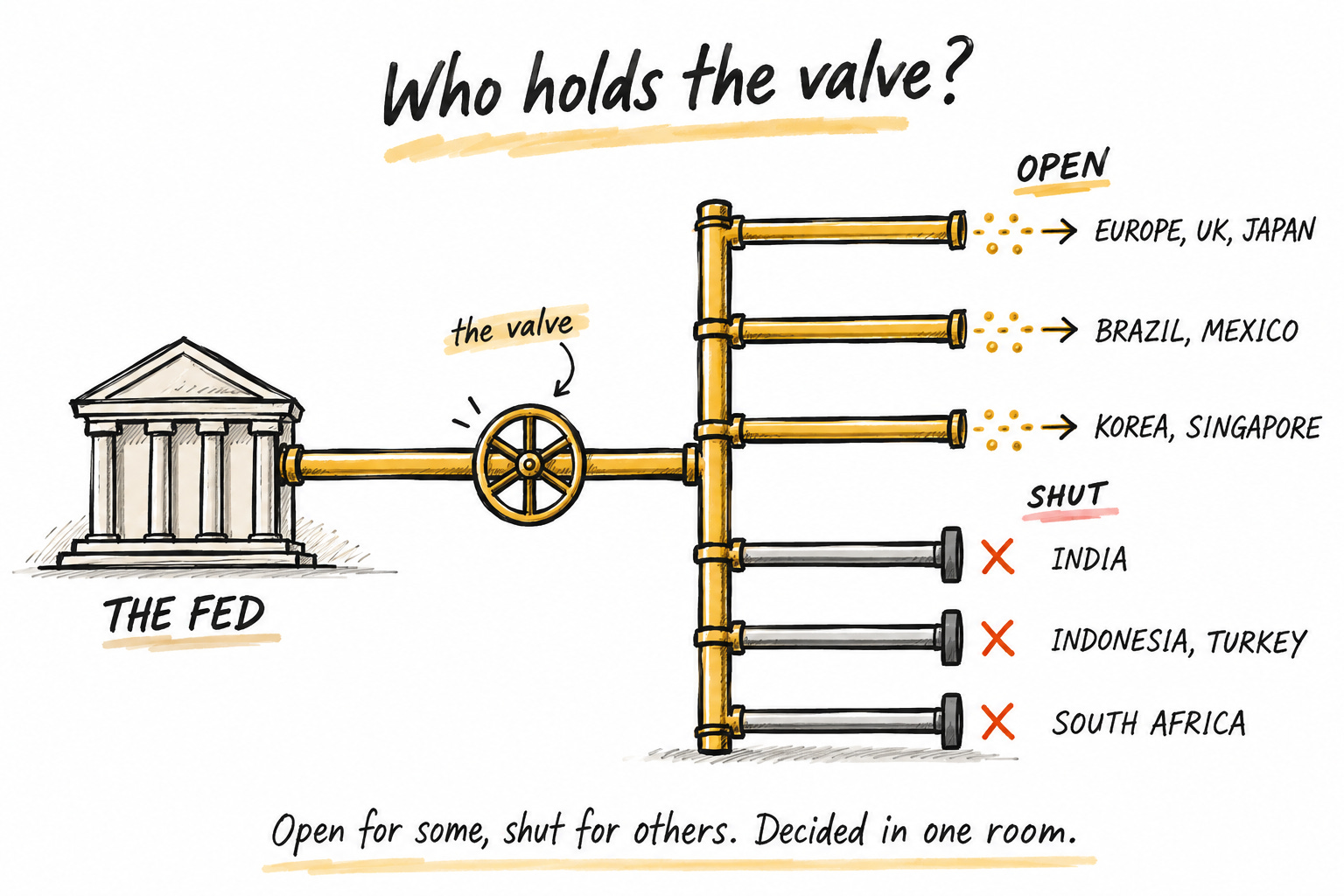
And to be fair, those swap lines worked. They stopped the panic from spreading much further. Ordinary people in a lot of countries were spared a great deal of pain without ever knowing why. Both things are true at once. The valve saved people. And somebody’s hand was on the valve.
Somewhere in all that wreckage, someone was paying close attention. On 3 January 2009, a programmer, or a group of them, working under the name Satoshi Nakamoto, switched on a new kind of money. Inside its very first block they left a newspaper headline from that morning: “The Times 03/Jan/2009 Chancellor on brink of second bailout for banks.”
A money with no Fed, no swap lines and no committee deciding who is fundamentally sound. Whatever you think of Bitcoin today, and I’ve been openly critical of what it’s turned into, it was born as a direct reply to those weeks. I went into that in Bitcoin was built for 2008. Part 6 picks up the thread from there.
13. TODAY
So here we are
Which brings us back to the numbers we started with, and to you.
Forty trillion dollars of debt. An interest bill bigger than the military. A lost credit rating. You now know why none of that has broken the dollar. The lenders can’t leave, and the borrower prints the money.
But the story didn’t end in 2008, and the bill keeps turning up in places that never agreed to pay it.
When did the price of something you buy last jump for no reason you could see? There’s a fair chance part of the reason was decided in Washington.
In 2022 America had an inflation problem again. The Federal Reserve raised interest rates faster than at any time in forty years. For America, that was medicine. For everyone else, it was weather. Money rushed out of other countries to chase the higher American rates, and the dollar shot up. The Japanese yen fell to its weakest in more than thirty years. The British pound, the money that ran the world a century ago, fell to its lowest price against the dollar in history. Egypt, Pakistan, Ghana and Sri Lanka were squeezed hardest, and two of them stopped paying their debts.
The strong dollar didn’t cause all of that. Sri Lanka had already wrecked its finances with tax cuts and money printing. Britain’s crash was set off by a disastrous budget in London. But the strong dollar found every crack. Does your country buy its fuel, its medicine or its wheat in dollars? Nearly every country does. So a meeting you’ll never attend helped set the price at your counter.
Nobody at that meeting was thinking about you. They weren’t cruel. They just weren’t thinking about you at all.
Our currency. Your problem.
There’s a twist here, and it’s an honest one. The Dallas Fed later looked at how developing countries got through 2022, and found most of the big ones did far better than in the 1980s. Their currencies fell only a little. The Mexican peso actually rose. Why? Because they’d learned. They borrowed more in their own money, raised rates early, and above all they held big piles of dollar reserves.
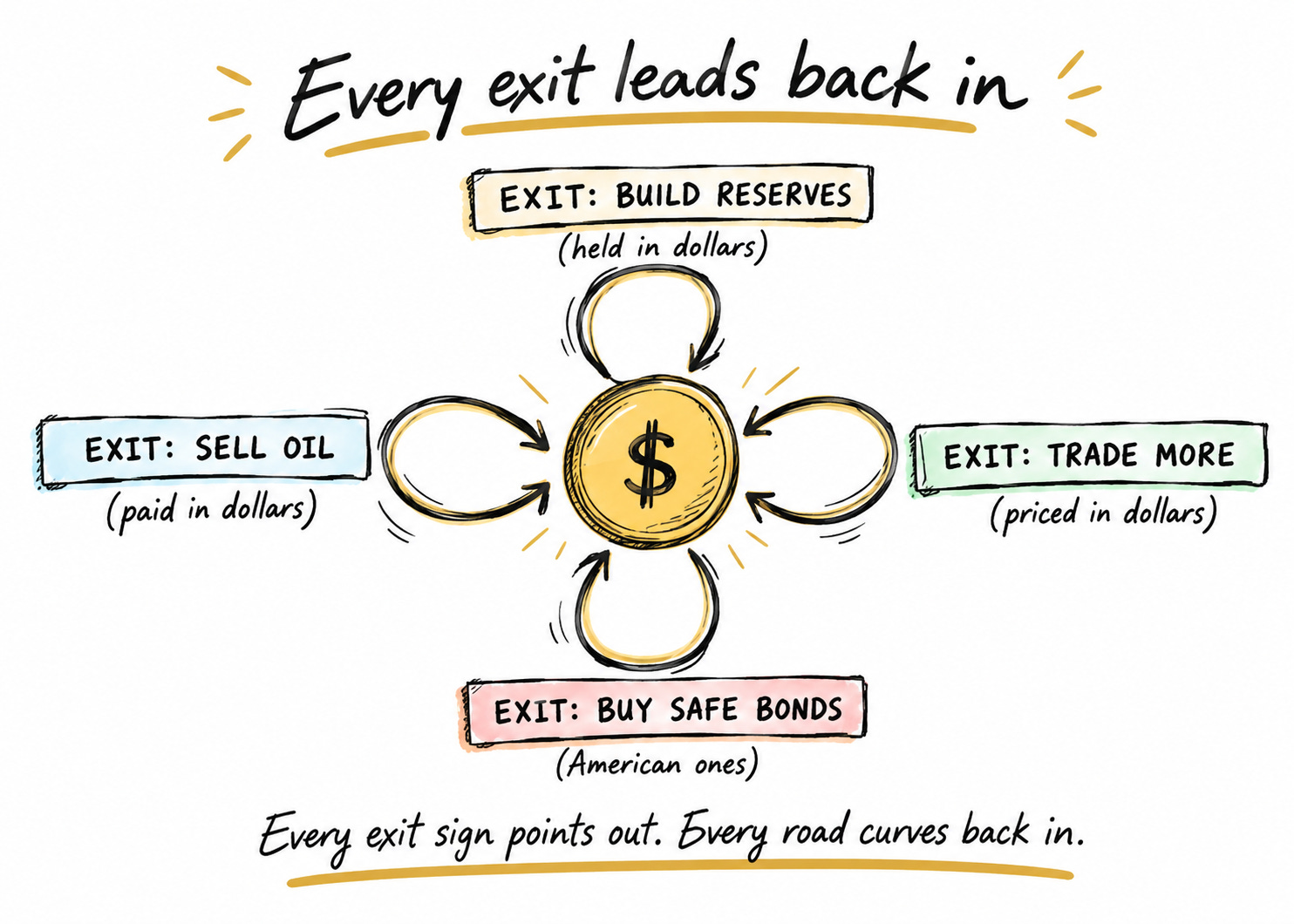
So the lesson of 1998 worked. It worked by holding even more dollars.
That’s the trap, seen from the outside. Every escape route from dollar pain runs straight back through more dollars.
That same year, the world found out what else those reserves could mean. After Russia invaded Ukraine in 2022, America and its allies froze roughly 300 billion dollars of Russia’s central bank reserves. Whatever you think of that decision, every central bank on Earth took note. Your savings are safe in the dollar system right up until Washington decides they aren’t.
Now the view from the other side of the table, because I promised American readers this seat wasn’t as comfortable as it looks.
Triffin’s warning never went away. For the world to keep holding dollars, America has to keep supplying them, which means running deficits year after year. The world lends. America spends. Neither side can easily stop. Interest alone now costs America close to a trillion dollars a year, and the government always needs new buyers for its debt.
One of the newest buyers is one almost nobody saw coming: stablecoins, the digital dollars that live on blockchains. A 2025 American law, the GENIUS Act, requires them to back every token with safe assets such as short-term US government debt. Tether, the biggest of them, now holds more American government debt than many countries do. I wrote about that in this piece on the 40 trillion dollar debt and USDT. The digital world that was supposed to escape the dollar has become one of its most dependable lenders.
So the exit hasn’t only locked behind the rest of the world. It has locked behind America too. The privilege and the trap are the same thing, seen from two sides of one table.
The trick only works for as long as the world has nowhere else to go.
And for the first time in eighty years, a lot of very serious people are working on somewhere else.
14. THE BIGGER MAP
The bigger map
Five issues in, the shape of the whole story is clear.
Amsterdam kept the world’s money in the 1600s and 1700s, until secret lending cracked the trust behind it. That was Part 1.
London took over, earned the world’s trust, and ran the planet’s money for a century on a thin sliver of gold. That was Parts 2 and 3.
New York took the crown between 1914 and 1956, invoice by invoice. That was Part 4.
And in this issue, New York found something none of the others ever had. A way to owe the world everything and still give the orders.
Every one of these keepers had the same flaw. The Dutch lent in secret. The British suspended their own rules when it suited them. America closed the gold window on a Sunday night, chose which countries got emergency dollars, and froze a country’s savings with a signature. The details change. The flaw doesn’t. Whoever runs the world’s money can change the rules, and you only find out on the day they use that power against you.
Remember what Keynes asked for at Bretton Woods in 1944. A world money that belonged to no single country. He even named it, the bancor. He lost, because America had the gold. The world has spent the eighty years since living in the version where one country owns the money everyone else needs.
So the question for Part 6 isn’t only who comes next.
The obvious answer is China, and China is building the pipes and buying the gold. But swapping one country’s money for another’s would just move the “your problem” sentence to a different capital.
The deeper question is whether the next money needs an owner at all. Rules that no government can change on a Sunday night. No committee deciding who counts as fundamentally sound. That’s the serious idea buried under all the noise about blockchains and digital money, and it’s why this newsletter exists. It’s the idea in our welcome post, One Planet, 180 Currencies, and Something’s Broken, and it’s the map in The Convergence.
I’m not selling you that future. It may never arrive. A lot of what wears its clothes is junk, and the dollar has outlived every prediction of its death so far. But you now know exactly why people are trying.
Layer 1 · Rails
who moves the money
Amsterdam, then London, then New York, and maybe next, open networks no single country controls.
Layer 2 · Money
what the value is counted in
The guilder, the pound, the dollar, and maybe next, something no government can print its way out of.
Layer 3 · Assets
what the world runs to when it is scared
Gold, then American government bonds, and maybe next, assets no ruler can freeze.
Layer 4 · Intelligence
who reads it all and acts first
Once a clerk with a ledger, then a trading floor, and now, more and more, software and AI agents.
Follow the rails, not the price. The price is the story they tell you. The rails are the story that’s true.
Reading changes nothing. Using it does. Here’s what to carry out of this one.
Your toolkit
Our currency, your problem.When Washington fixes an American problem, ask who gets the bill. Usually it’s someone who never had a vote.
Britain owed money it had to earn. America owes money it can print.That single difference explains why the biggest debtor in history still gives the orders.
Owe a little and you’re at their mercy. Owe enough, in your own money, and they’re at yours.Keynes called it an old saying. It may be the most important sentence in modern money.
A promise backed by gold lasts until someone asks for the gold.The dollar’s promise held for 27 years. It broke the moment enough people came to collect.
Watch who holds the valve.In a panic, the question isn’t whether there’s money. It’s who decides where it goes. In 2008 it was a committee in Washington.
The fix for the last crisis builds the next one.Asia swore “never again” in 1998, saved dollars, and helped pump up the bubble of 2008. Every fix just moves the pressure somewhere else.
Stop asking when the dollar collapses. Ask where the world would go instead.A currency this central doesn’t die of debt. It dies when the world finally has somewhere else to go.
Stack those on the kit from Parts 1 to 4. Cash versus credit. An interest rate is the price of doubt. When they tell you nobody decided, someone decided. You lose an empire on the invoice. And now: our currency, your problem.
The cousin with the machine in his garage has been borrowing from the whole town for more than fifty years now.
He’s been decent about it, mostly. He spent a fortune helping rebuild the town after the war, and people forget that. But whenever he’s had a problem, he has fixed it in a way that sent the bill to everyone else. And whenever he’s needed to, he has reminded people whose notes they’re holding.
He said so out loud once, in 1971. Our currency. Your problem.
Most of the time nobody says it anymore. It just happens. In the price of fuel in Accra. In the value of a pension in Buenos Aires. In the interest on a loan in Jakarta. In the cost of a phone in Delhi.
You don’t have to be angry about that. Anger isn’t the point. The point is to see it. Once you’ve seen it, you can’t read a headline about the Fed the same way again. “Washington raises rates” stops being American news. It’s news about your street.
Next time, in Part 6, the last part of this series, we follow the thread from that first Bitcoin block in January 2009 to right now. The gold rush inside central banks. China’s pipes. The digital dollars. And the question this whole series has been walking toward for four hundred years.
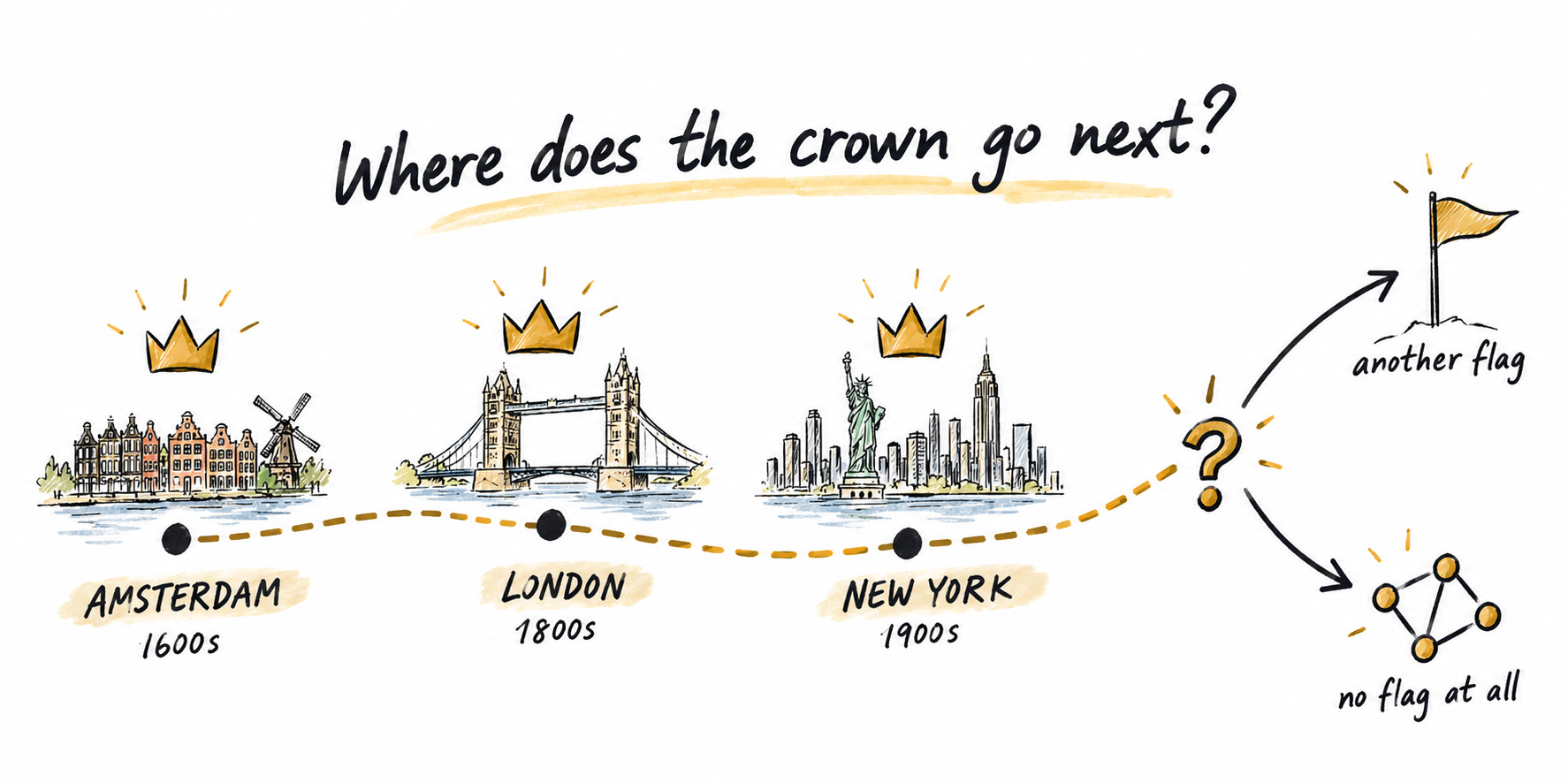
When the crown leaves New York, does it go to another flag? Or to no flag at all?
Thank you for staying with a long one.
Grow with me.
The market is always wearing clothes. Our job is to see it without them.
Keep pulling the thread
Read the series in order: Part 1 (the Dutch), Part 2 (how Britain got trusted), Part 3 Nobody Decided This (the century Britain ran the world’s money) and Part 4, You Do Not Lose an Empire in a Battle. You Lose It on the Invoice.
Sources and receipts
Every major claim, so you can check me.
Bretton Woods, the gold promise and Triffin’s warning
Nixon Ends Convertibility of US Dollars to Gold (Federal Reserve History) · Bretton Woods system · Triffin dilemma · Robert Triffin
Keynes’s 1945 memo
Owe your banker £1,000 and you are at his mercy (Quote Investigator)
De Gaulle, Giscard and Operation Vide-Gousset
Why France repatriated its gold from New York and London in the 1960s (Money Metals) · Exorbitant privilege
15 August 1971
Editorial note on the Camp David meetings (US State Department, Office of the Historian) · Nixon’s address to the nation, full text (American Presidency Project) · How the Nixon Shock remade the world economy (Yale Insights) · Nixon shock · Japan’s response to the Nixon shock (Hiroshi Ando, National Security Archive) · The British request before the window closed (BullionStar) · Consumer Price Index since 1913 (Federal Reserve Bank of Minneapolis)
Connally’s line
The dollar is our currency, but it’s your problem (EIU Corporate Network) · Managing the World’s Dollar Dependency (Council on Foreign Relations)
The 1974 Saudi deal and the petrodollar myth
The Untold Story Behind Saudi Arabia’s 41-Year US Debt Secret (Bloomberg) · No proof Saudi Arabia will stop using the dollar for oil (PolitiFact)
Volcker and the Latin American debt crisis
Volcker’s anti-inflation measures (Federal Reserve History) · Latin American Debt Crisis of the 1980s (Federal Reserve History) · Emerging markets and Fed rate hikes (Federal Reserve Bank of Dallas)
1985: America becomes a borrower nation, and the Plaza Accord
US Is Net Debtor for First Time Since 1914 (Washington Post) · Plaza Accord · Japan becomes world’s largest creditor (UPI)
The Asian financial crisis
The 1997-98 Asian Financial Crisis (Congressional Research Service) · Asian crisis timeline (PBS Frontline) · Gold-collecting campaign · A clearer picture of the day Suharto signed (Center for Global Development) · The Evolution of Poverty during the Crisis in Indonesia (World Bank)
The saving glut
The Global Saving Glut and the US Current Account Deficit (Ben Bernanke, Federal Reserve)
2008 and the swap lines
New dollar swap lines for Brazil, Mexico, Korea and Singapore (Federal Reserve) · US central bank swaps with 14 countries, 2007 to 2009 (Yale Program on Financial Stability) · Exchange rates during financial crises (Bank for International Settlements)
The dollar today
Currency composition of official reserves, Q1 2026 (IMF) · Interest costs on the national debt (Peter G. Peterson Foundation) · America now spends more on interest than defense (Visual Capitalist) · The 2025 US sovereign rating action (Moody’s) · US public debt passes 40 trillion dollars, September 2026 (IndexBox, from Treasury data) · Sri Lanka sovereign default · The British pound hit a record low (NPR)
-More Soon
The borrower becoming more powerful because the debt is denominated in its own currency is such an interesting reversal. The dollar’s real strength seems to be less about America’s balance sheet and more about how difficult the global system is to operate without it.
Thanks for the other Point of view. That's really fascinating how a borower could become the rulemaker, especially for the whole world.